Protecting Sound Wood Before It Isn't
Crawl Space Wood Treatment
& Rot Prevention
in Maryland
Protect sound wood before Maryland's humidity turns it into a repair job
Not every joist that looks questionable needs to be replaced. OBW probes every member first, then applies borate preservative treatment to sound wood and corrects the moisture source keeping it at risk, vapor barrier, drainage, or encapsulation. Backed by OBW's written workmanship guarantee, ask your inspector for the exact term. Honest, consultative guidance, not an upsell.
Protected
Protect What's Sound. Correct the Moisture.
Preventing Wood Rot
Before It Starts in a Maryland Crawl Space
Wood decay fungi need sustained moisture above roughly 19% wood moisture content to establish and spread. In an unprotected Maryland crawl space, that threshold is crossed regularly, Piedmont clay soils hold moisture after rain, Chesapeake summer humidity drives condensation on joist surfaces, and an inadequate vapor barrier lets soil moisture evaporate straight onto structural wood.
Preventive wood treatment works on sound wood, before decay has a chance to establish, or on lightly stained surface wood where the material beneath is still structurally intact. A borate preservative application makes wood fibers inhospitable to decay fungi and to some wood destroying insects, extending the useful life of framing that has not yet been damaged.
Treatment on its own is not the whole answer. OBW pairs every treatment scope with a look at what's driving moisture into the crawl space in the first place. Wood that is treated but sits in a persistently wet environment will still be challenged over time. Correcting the moisture source, vapor barrier, drainage, or full encapsulation, is what makes the protection last.
Catch It Before It's a Repair Job
Signs Your Crawl Space Wood
Needs Preventive Attention
These signs point to elevated decay risk, not necessarily active damage yet. That's exactly the window where treatment and moisture correction do the most good.
- Crawl space humidity consistently reading above 60%, even without standing water
- Light surface discoloration on joists that hasn't yet progressed to softness
- Missing, torn, or aging vapor barrier allowing soil moisture to evaporate freely
- Condensation visible on ductwork, pipes, or joist surfaces during summer months
- Preparing to sell and wanting documented proactive protection for a home inspection
What the Service Covers
What OBW's Wood Treatment
& Rot Prevention Includes
Scoped to protecting sound wood and correcting the moisture behind the risk.
Full Wood Assessment
Every accessible joist, beam, and post is probed and moisture tested before any treatment is recommended. Treatment is scoped to sound wood only.
Borate Preservative Application
Long lasting borate preservative applied to sound structural wood, protecting against fungal decay and reducing susceptibility to wood destroying insects.
Moisture Source Correction
Vapor barrier upgrade, drainage improvement, or encapsulation, whatever the assessment identifies as the active moisture source keeping wood at risk.
Vapor Barrier Installation
A properly sealed ground vapor barrier stops soil moisture from evaporating into the crawl space air, the single biggest factor in whether treatment holds up over time.
Dehumidification (Where Needed)
In crawl spaces with persistent high humidity beyond what a vapor barrier alone resolves, a dehumidifier keeps air moisture below the threshold that supports fungal growth.
Written Treatment Plan
A written plan explaining what was treated, what moisture correction is included, and realistic expectations for how long the protection holds up.
Assess First. Correct Moisture. Then Treat.
How OBW Prevents
Crawl Space Wood Rot
Four steps, in order. Treatment protects what moisture correction keeps dry.
Assessment & Sound-Wood Confirmation
OBW inspector probes every accessible member and takes moisture readings. Sound wood is identified as a treatment candidate; any structurally compromised wood is flagged separately for repair.
Moisture Source Correction
The moisture condition driving decay risk is addressed first, vapor barrier, drainage, or encapsulation, so treated wood goes into an environment that supports the protection rather than undoing it.
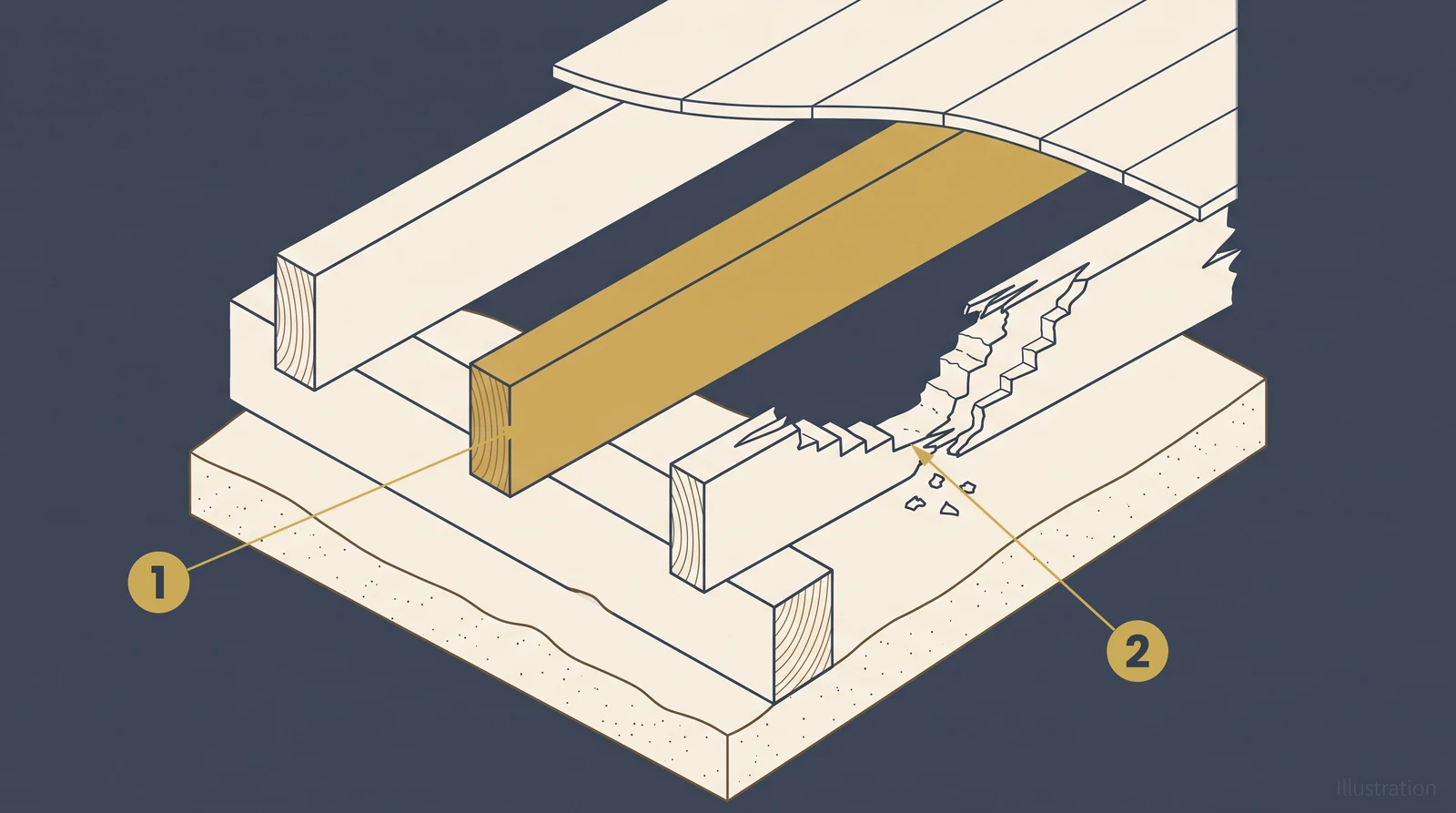
- Sound joist treated to stay sound
- Decayed wood that treatment cannot save
Borate Treatment Application
Sound structural wood receives a borate preservative application, extending its resistance to fungal decay and reducing susceptibility to wood destroying insects.
Documentation & Maintenance Guidance
Completed work is photographed. You receive a written record of what was treated and what was corrected, along with guidance on periodic checks to keep the crawl space protected.
Honest Answers. No Sales Pitch.
Common Questions About
Wood Treatment & Rot Prevention
Call (410) 879-3360 if your question isn't here. Our inspectors give honest, consultative guidance.
What is borate wood treatment, and how does it prevent rot?
Borate preservatives are water soluble compounds that penetrate wood fibers and make them inhospitable to the fungi that cause decay, along with wood destroying insects such as carpenter ants. Applied to sound, dry wood, borates provide long term protection against future decay without changing the wood's appearance or structural properties.
The treatment is only as good as the moisture conditions it goes into. Borate protects wood from decay organisms, but it does not stop wood from getting wet, and repeated soaking can reduce its effectiveness over time. That's why OBW pairs every treatment application with a moisture correction plan, vapor barrier, drainage, or encapsulation, so the crawl space environment supports the protection rather than working against it.
OBW applies borate treatment during new construction stage crawl space work, as a preventive measure on sound wood found during an inspection, and on replacement lumber alongside structural repairs as extra protection for adjacent members.
Can wood treatment be applied to wood that already has visible rot?
Treatment is appropriate for sound wood, including wood with minor surface staining or isolated surface fungal growth where the probe test confirms the wood beneath is still structurally intact. It is not a substitute for replacement where decay has already broken down the wood's cellular structure.
OBW's inspectors probe every accessible member with an awl and take moisture readings before recommending treatment. If a joist or beam probes soft, crumbles under light pressure, or shows significant cross sectional loss, it is a replacement candidate, not a treatment candidate. We are direct about that distinction rather than selling a treatment product to cover for damage that treatment cannot fix.
If your crawl space has a mix of sound and structurally compromised wood, which is common, OBW's assessment identifies each member individually. Members needing replacement are covered under our dry rot repair scope; members that are sound get preventive treatment as part of the same visit.
How long does a preventive wood treatment last in a Maryland crawl space?
Borate treatments are long lasting when the crawl space stays reasonably dry, but they are not a permanent, one time fix independent of moisture conditions. A crawl space with a properly installed vapor barrier, sealed vents, and controlled humidity gives treated wood a stable, protective environment for many years.
A crawl space that continues to take on groundwater, condensation, or high humidity will keep challenging any wood inside it, treated or not. This is why OBW frames wood treatment as one part of a larger moisture management plan rather than a standalone product. The moisture correction work, not the treatment alone, is what determines how long the protection holds up.
OBW recommends a periodic crawl space check, especially after treatment or encapsulation work, so any new moisture intrusion is caught early rather than after it has compromised the wood again.
Does treating my crawl space wood also protect against termites?
Borate treatments do have some deterrent effect on wood destroying insects, including termites, but OBW does not present preventive wood treatment as a substitute for termite protection. Termite prevention and monitoring is the role of a licensed pest control company with soil treatments, bait stations, and ongoing inspection programs specific to that purpose.
If you are looking for dedicated termite prevention, ask your OBW inspector, we can point you toward pest control companies we've worked with in the Baltimore metro area. Our wood treatment scope is focused on fungal decay prevention and general wood preservation, paired with the moisture control that also happens to make a crawl space less attractive to pests generally.
Is wood treatment enough on its own, or do I need encapsulation too?
It depends on your crawl space's current moisture conditions. If humidity, condensation, or ground moisture are actively pushing wood toward the fungal decay threshold, treatment alone will not resolve the underlying problem, it will simply be reapplied protection working against a moisture source that keeps returning.
OBW's assessment measures crawl space humidity, checks for vapor barrier condition, and identifies any active moisture sources before recommending a scope. In many Maryland crawl spaces, a partial or full encapsulation (vapor barrier, vent sealing, dehumidification) alongside wood treatment is the combination that actually keeps wood protected long term. In a crawl space that is already dry and well sealed, treatment alone may be sufficient as a preventive measure.
Your written assessment will lay out exactly what OBW recommends and why, with the reasoning tied to what our inspector found in your specific crawl space, not a one size fits all package.
70 Years of Maryland Crawl Spaces
Why Maryland Homeowners Choose
Oriole for Wood Treatment
Three generations of the Pirog family have been diagnosing and protecting Maryland crawl spaces since Frank Pirog Sr. founded Oriole in 1953.
Sound Wood Gets Treatment, Not Unnecessary Replacement
OBW probes every member before recommending a scope. If it's sound, we treat it and protect it, we don't replace wood that doesn't need replacing.
Maryland Humidity Expertise
We understand the specific moisture sources, Piedmont clay soil, Chesapeake summer humidity, condensation, that put Maryland crawl space wood at risk, and design treatment plans around them.
Backed by a Written Workmanship Guarantee
OBW stands behind its treatment and moisture correction work. Ask your inspector for the exact term that applies to your job.
Family-Owned Since 1953
Amber Pirog, Frank III's widow, leads the company. Three generations of straightforward advice, protecting wood that's still sound rather than upselling replacement.
No Pressure. No Obligation.
Three Steps to
Protected Crawl Space Wood
From assessment to treatment, most preventive projects wrap up in a single visit unless moisture correction work is also scoped.
Free Assessment
An OBW inspector probes accessible members, measures moisture content and humidity, and identifies whether treatment, moisture correction, or both are the right scope, at no charge and no obligation.
Written Treatment Plan
You receive a written plan explaining what will be treated, what moisture correction is recommended and why, and realistic expectations, with pricing before any work begins.
Treat & Protect
Our crew corrects the moisture source, then applies borate treatment to sound wood. Full photo documentation and written workmanship guarantee paperwork at closeout, ask your inspector for the exact term.
Protect Your Crawl Space Wood Before Rot Starts.
Free inspection. Written plan same day. Moisture corrected, sound wood protected.
Family-owned since 1953 · MHIC #4247 · Backed by OBW's written workmanship guarantee