
Following the Foundation Beneath It
Uneven Floors
in Your
Maryland Home
A floor doesn't go out of level on its own. It's following the foundation beneath it.
If a marble rolls toward one wall, or a door swings open by itself, that foundation has moved unevenly. OBW measures the slope across the room before recommending anything, since the degree of drop changes what actually needs to happen.

Differential Settlement, Explained
Why Floors Go Out of Level
in Maryland Homes
Most uneven floors trace back to differential settlement, one section of the foundation has settled more than another because the soil beneath it lost bearing capacity. In Maryland's Piedmont clay, that usually happens where drainage concentrates water near the footing, where a large tree's roots have drawn moisture from the soil, or where part of the house sits on fill material that was never as dense as the surrounding native clay.
A floor that's uniformly a little low across the whole house is a different, generally less urgent, situation than a floor that's noticeably lower in one corner or along one wall. Telling the two apart is exactly why measurement matters more than a rough feel underfoot.

Moisture control addressing one of the common drivers of differential settlement in Maryland clay

Measuring the Slope, Not Guessing at It
Warning Signs Your Floor
Is Following the Foundation
These signs, checked together, help confirm which section of the foundation moved and roughly when.
- A marble or ball that rolls toward one wall when set on the floor
- A door that swings open or closed on its own without being touched
- A slope that's clearly worse in one corner than across the rest of the room
- Wall cracks, gaps, or door and window symptoms near the sloped area
- A slope that's noticeably worse than it was a year or two ago
What's Included
OBW's Uneven Floor
Diagnosis & Repair
The repair scope follows the elevation map, not the other way around.
Floor Elevation Mapping
We measure floor elevation at multiple points across the room to map exactly where the slope starts and how much drop there is.
Related Symptom Check
Crack patterns, gaps, and door and window symptoms that travel with foundation-caused unevenness are checked to confirm the pattern.
Settled Section Identification
The specific foundation section responsible for the slope is identified based on the elevation map and related symptoms.
Foundation Settlement Repair
Piers driven or screwed to competent bearing strata transfer the load from the unstable soil to stable support.
Honest Leveling Assessment
Where structurally appropriate, leveling lifts the settled section back toward level. We tell you honestly what's achievable for your floor.
Written Workmanship Guarantee
Structural repair work is backed by a written workmanship guarantee. Ask your inspector for the terms that apply to your job.
The Process
How OBW Diagnoses and
Levels an Uneven Floor
Map the elevation. Check related symptoms. Transfer the load, then level where it's structurally appropriate.

Floor Elevation Mapping
OBW measures elevation at multiple points across the affected room, mapping exactly where the slope starts and how much drop there is.

Related Symptom Check
Crack patterns, gaps, and door and window symptoms elsewhere in the house are checked to confirm which foundation section moved.
Pier Installation
Piers are driven or screwed down to competent bearing strata, transferring the load away from the unstable soil beneath the settled section.

Leveling & Honest Assessment
Where structurally appropriate, the settled section is lifted back toward level, with an honest read on what's realistically achievable.
Photos From the Field
Job Site Photos
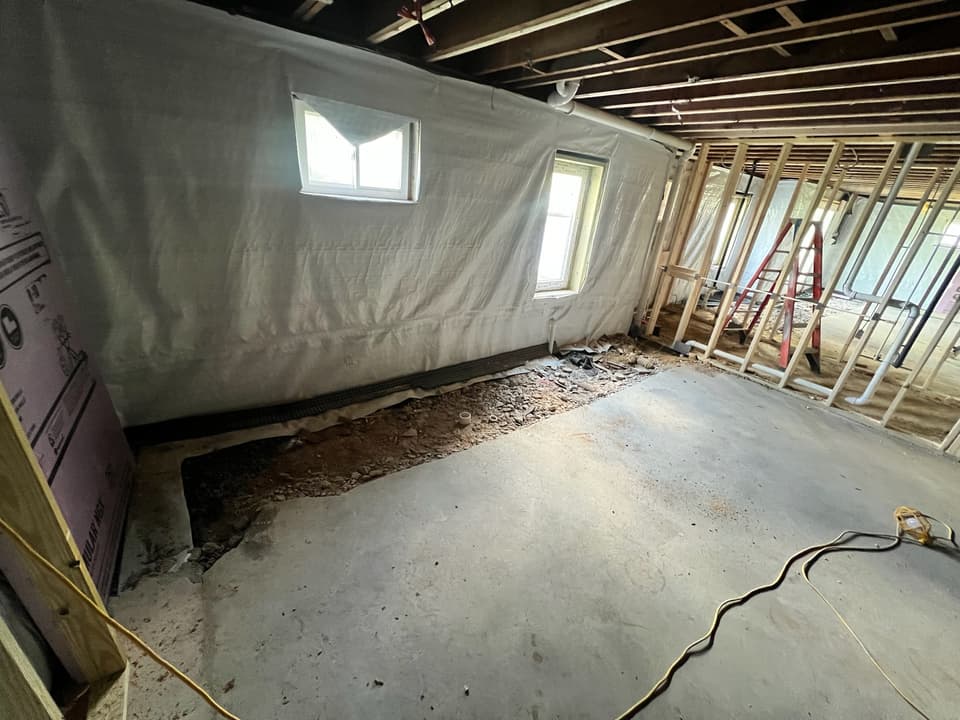
A closer look at the equipment, materials, and job site conditions involved in this kind of work.


Straight Answers
Uneven Floor Questions from
Maryland Homeowners
Call (410) 879-3360 if your floor feels out of level. Our inspectors measure before recommending anything.
How do I know if my floor is actually out of level, or if I'm imagining it?
A floor doesn't go out of level on its own. If you set a marble down and it rolls toward one wall, or a door has started swinging open by itself, the floor is following the foundation beneath it, and that foundation has moved unevenly.
A free OBW foundation inspection measures floor elevation at multiple points to map exactly where the slope starts and how much drop there is across the room, rather than relying on a rough feel underfoot.
Why does my floor slope more in one corner than across the whole room?
Most uneven floors trace back to differential settlement, one section of the foundation has settled more than another because the soil beneath it lost bearing capacity. In Maryland's Piedmont clay, that usually happens where drainage concentrates water near the footing, where a large tree's roots have drawn moisture from the soil, or where part of the house sits on fill material that was never as dense as the surrounding native clay. A floor that's uniformly a little low across the whole house is a different, generally less urgent, situation than a floor that's noticeably lower in one corner or along one wall.
Does the amount of slope actually change what needs to happen?
Significantly. A floor that's off by a quarter inch across 20 feet calls for a very different response than a floor that's dropped 2 inches at one corner. That's why OBW measures the slope rather than estimating it by feel. We also check for the crack patterns, gaps, and door and window symptoms that usually travel with foundation-caused unevenness, since they help confirm which section of the foundation moved and roughly when.
Can OBW actually get my floor back to level?
Sometimes, and sometimes only partially. Once the settled section is identified, foundation settlement repair transfers the load from the unstable soil to piers driven or screwed down to more competent bearing strata. Foundation leveling can then lift the settled section back toward its original position where that's structurally appropriate, though not every long-settled floor can or should be fully restored to level. OBW tells you honestly what's achievable for your specific floor before any work begins.
What does OBW check before recommending a repair?
We map the floor elevation across the affected area, identify which specific foundation section has settled, and check for related symptoms elsewhere in the house that confirm the pattern. That combination tells us whether piers, leveling, or a combination of both is the right scope for your specific situation. Backed by a written workmanship guarantee, terms vary by service, ask your inspector.
Why Oriole
Why Maryland Homeowners Trust
OBW with Uneven Floors
We Measure, Not Guess
A quarter inch of slope and two inches of slope need different responses. OBW maps the actual elevation before recommending anything.
Maryland Clay Expertise
Piedmont clay's bearing capacity shifts with drainage, tree roots, and fill quality. OBW has diagnosed differential settlement across every county we serve.
Honest About What's Achievable
Not every long-settled floor can or should be fully restored to level. We tell you what's realistic before any work begins.
Family-Owned Since 1953
Founded by Frank Pirog Sr. in 1953. Amber Pirog leads the company today. Written workmanship guarantee on every repair.
Reviews
What Our Maryland Neighbors Say
Differential Settlement Keeps Widening the Gap.
Getting Started on Your
Floor Assessment
The gap between the settled section and the rest of the foundation tends to grow, not shrink, without a fix.
Free Inspection
OBW maps floor elevation across the affected area and checks for related symptoms. Free, no obligation.
Written Diagnosis & Quote
You receive a written quote specifying pier placement and, where appropriate, leveling scope, before any work is scheduled.
Piering & Leveling
OBW's crew installs the piers and levels the section where structurally appropriate. Written workmanship guarantee issued upon completion.
Floors Going Out of Level in Your Home?
Free inspection. We measure the slope before recommending a fix.
Family-owned since 1953 · MHIC #4247 · Written Workmanship Guarantee