


Why Foundation Settlement Matters to Maryland Homeowners
Settlement in foundation is the downward movement of your home’s base as the soil underneath compresses. While some minor, even settlement is normal after construction, it becomes a problem when the movement is excessive or uneven. This can threaten your home’s structural integrity, your family’s safety, and your property value.
Quick Answer: What You Need to Know About Foundation Settlement
- Normal settlement happens evenly and rarely causes problems.
- Problematic settlement occurs when parts of your foundation sink at different rates.
- Common causes in our area include Maryland’s clay soils and moisture changes.
- Warning signs include stair-step cracks, sticking doors, and sloping floors.
- Professional solutions exist to stabilize your foundation and repair the damage.
Here in Maryland, our unique soil conditions make foundation settlement a common concern. From the fill soil under Baltimore City’s historic rowhomes to Harford County’s expansive clay, our local geology is prone to shifts that can affect your home.
We’ve been helping Maryland homeowners solve these problems for over 70 years. The key is spotting the warning signs early. A homeowner in Baltimore County told us they ignored a small crack above a door, thinking it was normal. Two years later, the crack was huge, the door wouldn’t close, and water was getting in. What could have been a simple fix became a major project.
In the sections ahead, we’ll explain what causes settlement in Maryland, how to spot the signs, and what proven solutions can protect your investment. You’ll learn the difference between normal settling and a real problem and when it’s time to call a professional.
What is Foundation Settlement and Why Does It Happen in Maryland Homes?
At its core, foundation settlement is the sinking of your home’s foundation into the ground. This happens when the soil beneath it can no longer support the structure’s weight. While a small amount of uniform settlement is expected after construction, significant or uneven sinking is a serious red flag.
The main culprit is almost always the soil. Here are the primary causes of problematic foundation settlement in our area:
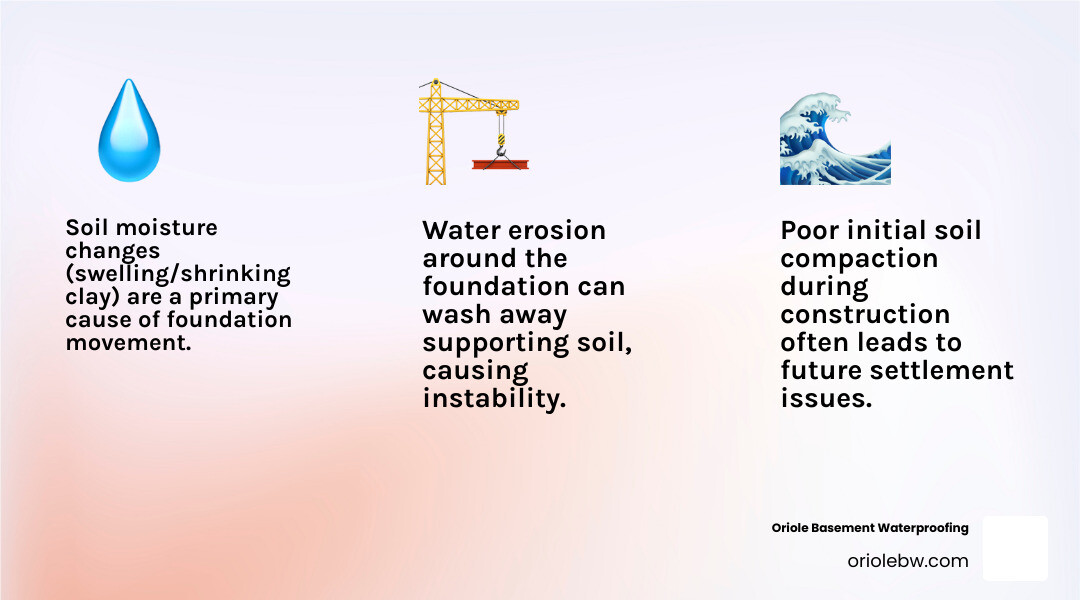
- Soil Moisture Changes: Maryland’s expansive clay soils are like a sponge. During dry spells, the soil shrinks, which can create gaps under your foundation and cause it to sink. Conversely, heavy rains common in Baltimore City can saturate the soil, causing it to soften and lose its ability to support your home’s weight. This is often due to poor drainage or plumbing leaks.
- Poor Initial Compaction: If the soil wasn’t packed down properly when your home was built, it will naturally compress over time under the massive weight of the structure. This compression is rarely even, leading to differential settlement where one part of the house sinks more than another.
- Soil Type and Erosion: Our local clay soils are known for shrinking and swelling. Other soils, like sandy types, can easily wash away, creating voids beneath the foundation. The specific soil your home is built on plays a huge role in its stability.
- Maturing Vegetation: Large trees and shrubs planted too close to a foundation can draw significant moisture from the soil, causing it to shrink and settle. If a large tree is removed, the decaying roots can also leave voids, leading to localized sinking.
- Other Factors: Less common causes include vibrations from heavy traffic or nearby construction, which can cause soil to compact more quickly. In some geological areas, the formation of sinkholes can cause catastrophic settlement, though this is not a primary concern in our direct service areas.
Understanding these causes is the first step. A professional inspection is the only way to pinpoint the exact reason for your foundation’s movement and determine the right solution.
Decoding the Signs and Solutions for Settlement in Foundation
Uniform vs. Differential Settlement: What’s the Difference?
Not all settlement is the same. The difference between uniform and differential settlement is key to understanding the risk to your home.
Uniform Settlement: This is when the entire house sinks evenly. Because the structure remains level, it typically causes minimal damage. For most conventional buildings, up to 50mm of total uniform settlement is considered tolerable.
Differential Settlement: This is the real troublemaker. It happens when different parts of the foundation sink at different rates, putting immense stress on your home’s frame. This uneven movement is what causes major structural damage. Anything over 20mm of differential settlement can be a serious problem.
TABLE: Uniform vs. Differential Settlement
| Feature | Uniform Settlement | Differential Settlement |
|---|---|---|
| Movement | Entire foundation sinks evenly | Parts of the foundation sink unevenly |
| Severity | Generally less severe, often considered normal | Highly severe, leads to structural damage |
| Structural Impact | Minimal; structure remains level and stable | Significant; causes distortion, cracks, and instability |
| Common Signs | Slight overall lowering; utility connections might be stressed | Stair-step cracks, sticking doors/windows, sloping floors, bowing walls |
| Urgency | Low; usually no immediate action required | High; requires prompt professional assessment and repair |
Differential settlement is the cause of most foundation failures and requires immediate attention.
Common Warning Signs of Problematic Settlement
Your home will often show signs of distress when differential settlement is occurring. Here’s what to look for:
- Stair-Step Wall Cracks: Diagonal cracks in brick or block walls are a classic sign. If they are wider than an eighth of an inch, it’s a serious concern. Learn more on our Fix Basement Crack page.
- Cracks in Floors or Ceilings: New or widening cracks in concrete slabs, tile, or drywall can indicate foundation movement.
- Sticking Doors and Jammed Windows: When frames are twisted out of square by settlement, doors and windows will begin to stick or jam.
- Sloping or Uneven Floors: A floor that feels tilted is a clear sign that the foundation beneath it is no longer level.
- Bowing Basement Walls: Inward bowing or bulging walls are caused by intense external soil pressure and signal a severe structural problem. Our Bowing Basement Wall: The Ultimate Guide has more info.
- Leaning Chimneys: A chimney pulling away from the house is a strong indicator of localized settlement.
- Gaps Around Frames: Noticeable gaps forming between window or door frames and the wall are another sign of shifting.
Ignoring these signs allows the damage to worsen. Early detection is key to protecting your home’s value and safety.
Professional Solutions for Settlement in Foundation
Addressing foundation settlement is not a DIY job. It requires professional expertise to ensure a permanent solution. We provide engineering-backed repairs to restore your home’s stability.
Our primary foundation repair services include:
- Carbon Fiber Straps for Bowing Walls: These incredibly strong straps are applied to bowing walls to reinforce them and prevent further inward movement, restoring the wall’s integrity.
- Sill Plate Replacement: The sill plate connects your home’s frame to the foundation. We replace rotted or damaged sill plates to ensure this connection is secure.
- Support Beam Replacement: Damaged or sagging beams that carry the weight of your home are replaced to restore structural support.
- Lolli Column Installation: We install these adjustable steel columns to provide additional support to sagging floors and beams in basements or crawl spaces.
- Floor Joist Replacement: We replace cracked or warped floor joists to ensure your floors are level and sound. See our Sub-Floor Replacement page for details.
We partner with structural engineers on every major repair to create a custom, long-term solution for your home. Learn more at our Foundation Repair MD page.
How to Prevent Future Settlement Issues
While you can’t change the soil your house is on, you can manage water around it. This is the number one factor in preventing settlement.
Here are our top prevention tips:
- Manage Water Runoff: Ensure your yard is graded to slope away from your foundation. This is the most critical step.
- Maintain Gutters: Clean your gutters regularly to prevent water from overflowing and saturating the soil near your foundation.
- Use Downspout Extensions: Extend your downspouts to discharge water at least 10 feet away from your home. We offer Down Spout Extensions & Exterior Drainage solutions.
- Maintain Consistent Soil Moisture: In dry periods, lightly watering the soil around your foundation can prevent the soil from shrinking excessively.
- Landscape Strategically: Plant large trees and shrubs a safe distance away (at least 15-20 feet) to keep their roots from affecting your foundation.
- Fix Plumbing Leaks: A hidden leak can saturate the soil and cause significant settlement over time. Address any leaks immediately.
Taking these steps can safeguard your foundation from future problems. For more on water management, see our Basement Waterproofing Maryland: The Ultimate Guide.
Protecting Your Home’s Future: Next Steps for Foundation Stability
Settlement vs. Subsidence: Understanding the Lingo
While the terms are often used interchangeably, settlement and subsidence are different. Understanding the distinction helps clarify the problem.
- Settlement is when the weight of your house compresses the soil directly beneath it, causing the structure to sink. The house is the cause of the movement.
- Subsidence is when the ground itself sinks, taking the house with it. This is caused by external factors like the collapse of underground voids or large-scale dewatering, not the weight of the house.
Both can cause similar damage, but the underlying problem and the required solution can be very different. Our expertise is in diagnosing and fixing settlement issues related to your home’s interaction with the soil it rests on.
Measuring and Monitoring Settlement in Foundation
If you suspect you have a settlement problem, the next step is a professional assessment. While you can mark cracks to see if they grow, accurate measurement is crucial for understanding the rate of movement.
Professionals use advanced techniques to track foundation movement. These can include precise elevation surveys and other specialized tools to measure displacement over time, as detailed in technical papers like Using Surveying Instruments in Monitoring 3D Deformations. The goal is to determine if the settlement is ongoing and if it exceeds acceptable limits, which for many homes is around 20mm of differential settlement.
When should you call a professional? Immediately. If you see stair-step cracks wider than an eighth of an inch, bowing basement walls, or doors and windows that are clearly out of alignment, don’t wait. The sooner the situation is assessed, the more straightforward the solution is likely to be.
With over 70 years of experience serving Baltimore City, Baltimore County, and Harford County, Oriole Basement Waterproofing is your trusted local expert. We offer a free, no-obligation inspection to accurately diagnose your foundation issues. Our engineering-backed solutions and lifetime transferable guarantee mean you can trust us to create a strong, dry, and healthy foundation for your home.
Don’t let minor foundation issues turn into major headaches. Contact us today to schedule your free inspection and let us help you protect your most valuable asset. We’re here to help you understand and address any Waterproofing Foundation Cracks or settlement concerns you may have.