


Why Maryland Homeowners Need to Fix Settlement Cracks Before They Get Worse
Fix settlement cracks as soon as you spot them, before they grow from a cosmetic annoyance into a costly structural problem. Here’s a quick breakdown of what to do:
Quick Guide: Identifying Settlement Cracks
| Crack Type | Width | Action |
|---|---|---|
| Hairline (drywall, plaster) | Under 1/8 inch | Professional monitoring |
| Vertical or diagonal (foundation) | 1/8 to 1/4 inch | Professional assessment |
| Stair-step (brick or block) | Any size | Professional assessment |
| Horizontal (foundation wall) | Any size | Immediate professional help |
| Any crack with water, bowing, or sticking doors | Any size | Call a pro now |
Here’s the thing about older Maryland homes: they settle. It’s normal. The soil shifts, the seasons swing from humid summers to freezing winters, and the ground beneath your home moves with it.
Most of the time, that settling produces nothing more than a hairline crack in your drywall. No big deal.
But sometimes, those cracks are telling you something more serious. A stair-step crack running up a brick wall in Baltimore City. A horizontal crack in a Harford County basement. A door that suddenly won’t close right. These aren’t cosmetic issues. They’re warning signs.
The tricky part? It can be hard to tell the difference on your own. And the consequences of getting it wrong, like patching over a structural crack and calling it done, can be significant.
That’s exactly what this guide is here to help with.
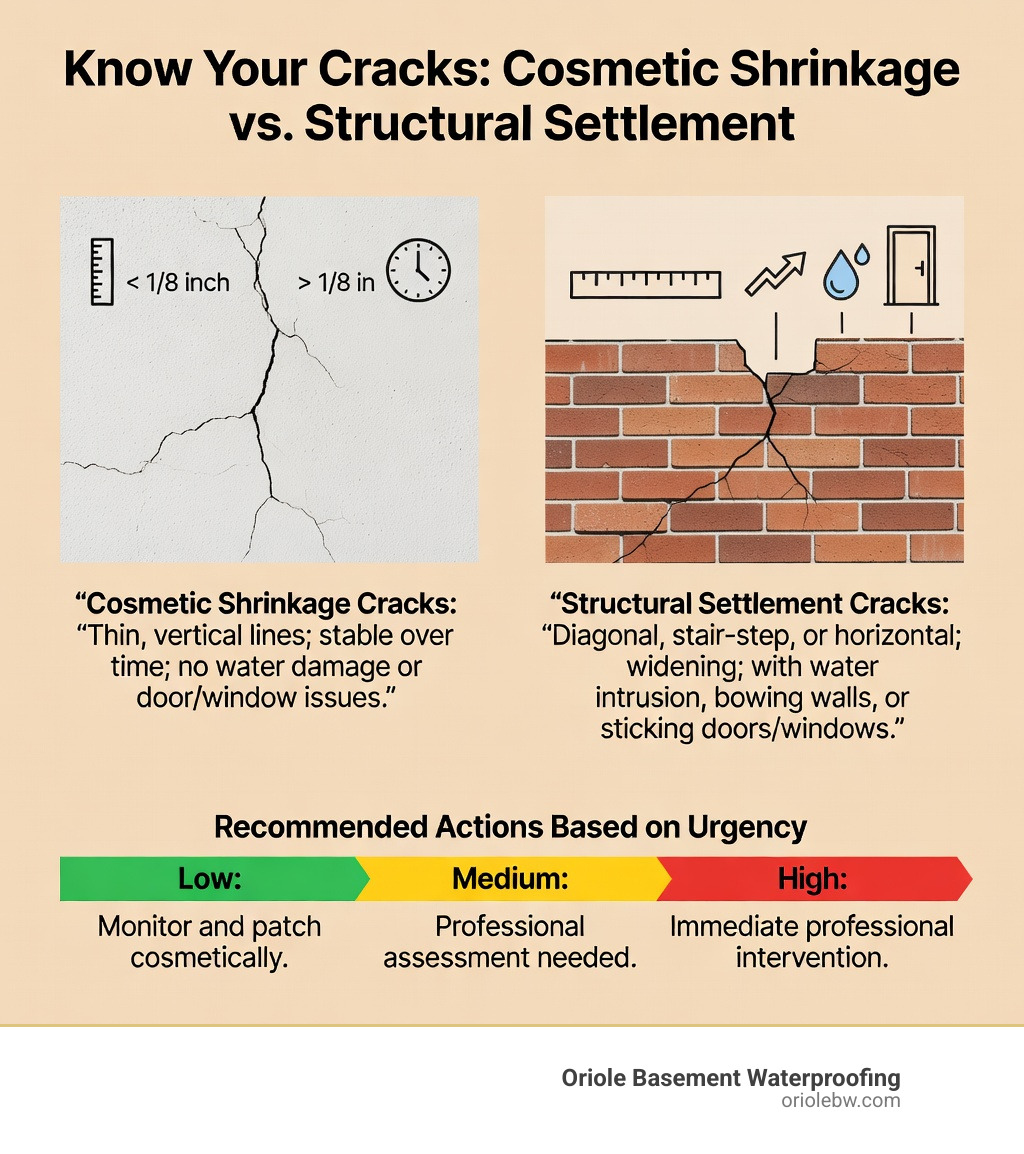
Simple guide to fix settlement cracks terms:
Understanding When to Fix Settlement Cracks in Your Maryland Home
Living in the Baltimore area means dealing with a specific kind of geology. In many parts of Baltimore County and Harford County, the soil has a high clay content. This clay is like a sponge. When we get those heavy Maryland spring rains, the soil expands and pushes against your foundation. When the summer heat hits, the soil shrinks and pulls away.
This constant “push and pull” creates hydrostatic pressure. Over decades, this pressure can cause the foundation to shift or settle unevenly. While normal foundation settling cracks are often vertical and less than 1/8 inch wide, structural failure looks different.
If you see stair-step cracks in your brickwork or diagonal cracks that are wider at the top than the bottom, your home is trying to tell you that the foundation is moving more than it should. You might wonder, are those diagonal wall cracks a big deal? The answer is usually yes if they are growing or wider than a dime.
Identifying the Best Time to Fix Settlement Cracks
The best time to fix settlement cracks is the moment you realize they aren’t just cosmetic. We tell our neighbors in Baltimore City to look for the “Warning Trio”:
- The Width: If the crack is wider than 1/8 inch (about the thickness of two pennies), it’s time for an expert to take a look.
- The Operation: Are your doors sticking in the winter? Do your windows feel like they are glued shut? This often means the house frame is warping because the foundation beneath it has shifted.
- The Direction: Vertical cracks are often just shrinkage from when the concrete was first poured. Horizontal cracks, however, are a major red flag. They suggest that the soil is pushing your basement wall inward.
According to Hippo’s guide on wall health and home safety, the timing and severity of these cracks can depend on factors like local climate and soil moisture. In our experience, if a crack is rapidly expanding or letting in water, the “best time” to fix it was yesterday.
Why Professional Intervention is the Only Way to Fix Settlement Cracks Permanently
It is tempting to grab a tub of spackle or some hydraulic cement from the hardware store and call it a day. But if the root cause is structural settlement, a surface patch is like putting a band-aid on a broken leg. The crack will just return, often wider than before.
At Oriole Basement Waterproofing, we use engineering-backed solutions to address the actual cause of the movement. This might involve installing carbon fiber straps to stop a wall from bowing or replacing rotted sill plates and damaged support beams. We even partner with structural engineers for major repairs to ensure your home remains stable for another 70 years.
| Feature | DIY Surface Patch | Professional Structural Stabilization |
|---|---|---|
| Primary Goal | Hide the crack | Stop the movement |
| Materials | Caulk, spackle, or cement | Carbon fiber, steel beams, structural wood |
| Durability | Temporary (often fails in 1-2 years) | Permanent (Lifetime Warranty) |
| Structural Integrity | None | Restores load-bearing capacity |
| Cost | Low upfront, high long-term | Investment in home value |
Understanding the different 5 Foundation Repair Methods can help you see why a professional touch is necessary for anything beyond a hairline blemish.
Professional Solutions for Lasting Foundation Stability
When we step into a basement in Harford County or a rowhome in Baltimore City, we aren’t just looking at the crack. We are looking at the forces acting on your home. If your walls are bowing inward due to lateral pressure from the soil, we need to reinforce the structure, not just seal the gap.
Stabilizing Bowing Walls with Carbon Fiber Straps
For many homeowners, the idea of foundation repair brings up nightmares of excavating the entire yard. Thankfully, modern technology has given us a much better way. We use carbon fiber straps to stabilize walls that have started to bow or lean.
These straps have a higher tensile strength than steel but are thinner than a penny. We bond them directly to your basement walls using a high-strength epoxy. This creates a permanent reinforcement that prevents the wall from moving inward any further. It’s non-invasive, doesn’t require digging up your landscaping, and comes with our lifetime transferable guarantee. If you’re dealing with these specific issues, learning about professional horizontal foundation crack repair usually starts with this kind of stabilization.
Replacing Damaged Support Beams and Sill Plates
Sometimes the problem isn’t just the concrete. In many older Baltimore County homes, moisture in the crawlspace or basement leads to wood rot. When your sill plate (the wood that sits directly on the foundation) or your support beams rot, the whole house can begin to sag.
We specialize in:
- Sill Plate Replacement: Swapping out rotted wood for pressure-treated lumber.
- Support Beam and Floor Joist Replacement: Restoring the “bones” of your home so your floors are level again.
- Lolli Column Replacement: Updating old, rusted support posts with modern, adjustable steel columns.
By redistributing the structural load correctly, we can often stop settlement cracks from getting any worse. If you’re unsure where to start, check out our guide on what to do if your foundation needs repair.
The Role of Crawl Space Encapsulation in Prevention
One of the most effective ways to fix settlement cracks long-term is to control the environment around your foundation. In Harford County, humidity levels can skyrocket, leading to soil changes and wood decay.
Crawl space encapsulation involves sealing the floor and walls with a heavy-duty vapor barrier and integrating a dehumidifier. This keeps the soil moisture levels consistent and protects your floor joists from rot. It’s a holistic approach that stops problems before they start. As noted in scientific research on repairing cracks in concrete, managing the environment is key to preventing the expansion and contraction that leads to cracking in the first place. For more details, see our basement crack repair guide.
Conclusion and Next Steps for Your Foundation
We’ve been helping our neighbors in Baltimore City, Baltimore County, and Harford County for over 70 years. We’ve seen every type of crack imaginable, from the tiny ones in new builds to the scary ones in historic estates.
If you’re worried about a crack in your home, don’t wait for the next heavy rain to see if it gets bigger. A quick professional assessment can give you the peace of mind that your home is safe, or provide a clear, engineering-backed plan to fix it for good. We pride ourselves on our transparent pricing and our lifetime transferable warranty.
Ready to protect your biggest investment? Schedule a professional foundation crack assessment with the team at Oriole Basement Waterproofing today. We’ll help you say goodbye to those cracks and hello to a strong, dry home.