



Your Guide to a Dry, Healthy Maryland Basement
Interior drainage systems are designed to collect water that seeps into your basement and channel it away from your home’s foundation before it can cause damage. Here’s what Maryland homeowners need to know:
Quick Answer: How Interior Drainage Systems Work
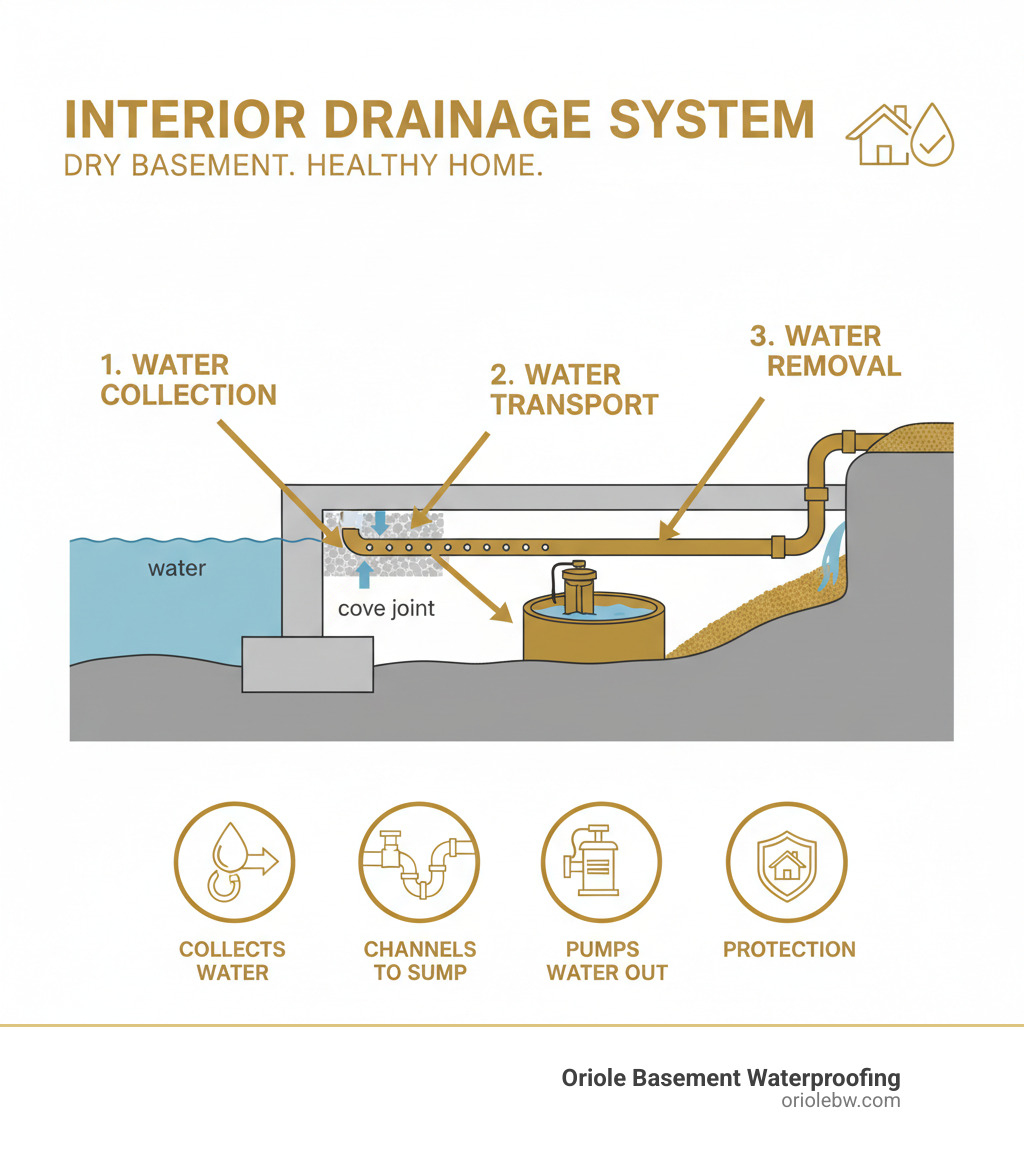
- Water Collection – Perforated pipes installed along the basement perimeter collect water at the cove joint (where the floor meets the wall).
- Water Transport – The system channels collected water to a sump pump basin.
- Water Removal – A sump pump automatically pumps the water away from your foundation.
- Protection – Prevents flooding, structural damage, mold growth, and foundation issues.
If you’ve noticed water on your basement floor, damp walls, or a musty smell, you’re dealing with a problem thousands of Maryland homeowners face. Our state’s clay-heavy soil and unpredictable weather create the perfect conditions for basement water intrusion.
The good news? An interior drainage system can solve these problems for good. Unlike exterior waterproofing that requires digging up your yard, interior systems are faster to install (usually 1-2 days), cost about 50% less, and can be installed year-round.
At Oriole Basement Waterproofing, we’ve protected Maryland basements for over 70 years. From the rowhouses of Baltimore City to homes in Harford County, we’ve seen every water problem our local weather can cause. We provide solutions that actually work, not just temporary fixes.
Understanding Interior Drainage Systems: How They Work and Why You Might Need One
What Causes Basement Water Problems in Maryland?
When you find a puddle on your basement floor, the cause is usually a combination of factors unique to our region. The biggest culprit is hydrostatic pressure. After a heavy Maryland rainstorm, the soil around your foundation becomes saturated. This waterlogged soil pushes against your basement walls and floor with incredible force, eventually finding a way inside.
Concrete looks solid, but it’s porous. Under pressure, water seeps through tiny cracks or, most commonly, through the cove joint (the seam where your basement floor meets the wall). This joint is often the weakest point in your basement’s defense. Research from the University of Minnesota Extension confirms that hydrostatic pressure and cove joint seepage are among the most common causes of basement moisture problems.
Our area’s saturated soil is a major issue. When the ground can’t absorb any more water, the excess moisture flows toward the path of least resistance: your basement. Poor exterior grading or clogged gutters only make the problem worse by directing water right to your foundation.
Foundation cracks act as direct highways for water. Over time, water intrusion can worsen these cracks, especially with Maryland’s freeze-thaw cycles. Water enters a crack, freezes and expands, and makes the crack larger, turning a small issue into a serious structural problem. We’ve helped homeowners in Baltimore City, Baltimore County, and Harford County solve these exact issues for decades. The problem is common, and more importantly, it’s fixable.
For a deeper look at what might be causing your specific water problem, check out our guides on Wet Basement Repair Expert Solutions and Causes and What to Do If You Have a Wet Basement.
How an Interior Drainage System Protects Your Home’s Foundation
Instead of trying to build an impenetrable barrier around your foundation, an interior drainage system takes a smarter approach. It works by intercepting water after it enters the basement perimeter but before it can spread across your floor.
Here’s how it protects your foundation: Perforated pipes are installed just below the floor along the inside perimeter. They are positioned to catch water the moment it seeps through the walls or the cove joint. Some systems even include a flange that extends up the wall to catch trickles before they hit the floor.
This collected water flows through the pipes to a sump pump basin. When the water in the basin reaches a certain level, the pump automatically activates, pushing the water through a discharge line and safely away from your home. This constant cycle of collection and removal provides powerful benefits:
- Prevents Structural Damage: By relieving hydrostatic pressure, the system stops the force that causes foundation cracks, bowing walls, and erosion. A dry foundation is a stable foundation. Learn more on our Foundation Repair MD page.
- Improves Air Quality: A dry basement is an unhealthy basement. By eliminating dampness, the system prevents mold and mildew growth, getting rid of musty odors and creating a healthier environment for your family.
- Protects Your Belongings: Your stored items, such as family photos, tools, and furniture, stay safe from water damage.
One of our Baltimore County customers said it best: “I used to cringe every time it rained, wondering what I’d find in the basement. Now I don’t even think about it.” That peace of mind is priceless.
To learn more about the entire waterproofing process, check out How Basement Waterproofing Works.
Types of Interior Drainage Systems and Their Components
There is no one-size-fits-all solution for basement waterproofing. We customize our approach based on your home’s foundation and specific water problem. The two main types of interior drainage systems are below-slab drain tile and on-slab baseboard systems.
Below-slab drain tile is our most common and effective solution. We place a perforated pipe in a small trench below your floor, where it captures water at its source and directs it to the sump pump. This method is ideal for handling significant water intrusion in both poured concrete and block foundations.
On-slab baseboard systems are a less invasive option where a drainage channel is installed on top of the floor against the wall. It’s a good solution for monolithic foundations (where the floor and footing are one piece) or for basements with minor seepage.
Here’s a quick comparison:
| Feature | Below-Slab Drain Tile | On-Slab Baseboard Systems |
|---|---|---|
| Cost | Generally higher due to concrete work | Often lower, less labor-intensive |
| Installation | More involved, requires concrete removal | Less invasive, installed on the existing floor |
| Effectiveness | Highly effective for all types of water intrusion | Effective for wall seepage and minor intrusion |
| Best Use Cases | Poured & block foundations, significant water problems | Monolithic foundations, minor seepage |
Regardless of the system, these key components work together:
- The Sump Pump: This is the heart of the system. It automatically pumps all the collected water out of your basement and safely away from your home.
- Battery Backups: We consider this essential, not optional. A battery backup ensures your pump keeps working during a power outage, which is exactly when you need it most. Learn why this is so critical on our Sump Pump Battery Backups page.
- Vapor Barriers: These membranes are installed on walls to block moisture vapor, which helps control humidity and improve air quality. They are a crucial part of our Crawlspace Encapsulation services.
Interior vs. Exterior Drainage: What’s the Right Choice?
For most Maryland homeowners dealing with an existing water problem, an interior drainage system is the smarter choice. It offers clear advantages over exterior methods.
- Cost-Effective: Interior systems typically cost about 50% less than exterior systems, which require massive excavation.
- Faster Installation: We can usually complete an interior installation in 1-2 days, compared to the weeks an exterior project can take.
- Less Invasive: All work is done inside your basement. Your landscaping, driveway, and patio remain completely untouched.
- Year-Round Installation: Because we work inside, we can install your system in any season, rain or shine. You don’t have to wait months for a dry basement.
An interior system is the ideal solution for existing homes with water intrusion, especially if you have established landscaping or limited exterior access, like with many Baltimore City rowhouses. While exterior systems try to block water, interior systems efficiently manage it, keeping your basement dry without tearing up your property.
For a deeper comparison, explore our guides on Comparing Basement Waterproofing Systems and Basement Waterproofing System Types, Costs, and Advantages.
Signs You Need an Interior Drainage System
Your home will tell you when there’s a water problem. Ignoring these signs can lead to costly structural damage and health concerns. Here are the five warning signs you shouldn’t ignore.
- Water on the floor: Any puddles, damp spots, or wet areas that appear after rain.
- Damp walls or efflorescence: Clammy-feeling walls or a white, chalky powder on the concrete are clear signs of water passing through.
- Musty smells: That damp, earthy odor is evidence of mold and mildew growth, even if you can’t see it.
- High humidity: If your basement feels muggy or damp, you have excess moisture that promotes mold and condensation.
- Visible mold or mildew: Black, green, or white patches are proof of a moisture problem. If you see mold along with active water intrusion, that’s our specialty. For mold issues without a water problem, we can refer you to our trusted partners at Raven Mold.
Don’t wait for a flood to take action. These signs are your home’s way of asking for help. To understand more about why addressing these issues quickly matters, check out 6 Signs You Need to Get Your Basement Waterproofed.
The Installation and Maintenance of Interior Drainage Systems
The Professional Installation Process
Our professional installation is a precise, efficient process we’ve perfected over 70 years. Instead of a messy, weeks-long excavation, our team works cleanly inside your basement, typically finishing in just 1-2 days. We handle everything: preparing the area, creating a channel for the drainage system, installing the perforated pipes and sump pump, and restoring the concrete for a clean finish. We also ensure the discharge line carries water safely away from your home, with special attention to preventing freezing in Maryland winters.
Essential Maintenance for Long-Term Effectiveness
Your system is low-maintenance, but a little care goes a long way to ensure its reliability:
- Test Your Sump Pump: Pouring a bucket of water into the basin every few months is a simple way to test that the pump activates correctly.
- Keep it Clean: It’s important to check that the pump’s intake screen and the exterior discharge line are clear of debris. For more tips, see our guide on How to Clean Your Sump Pump.
- Schedule Professional Checkups: Our annual maintenance plans help catch small issues before they become big problems, giving you year-round peace of mind.
System Limitations and Radon Gas Considerations
A sump pump is a mechanical device, which is why a battery backup is essential to protect against power outages or failure. Additionally, any work on your basement slab can affect radon gas levels. Radon is a naturally occurring gas in some Maryland soils. We recommend testing for radon, and we can integrate mitigation solutions, like sealed sump covers, into your system. The CDC offers more information on radon testing.
Secure Your Foundation with a Dry Basement for Good
We know the worry that comes with a wet basement. Every rain forecast is a concern, and that musty smell is a constant frustration. For over 70 years, we’ve been giving Maryland families a permanent solution and peace of mind.
An interior drainage system is an investment in your home’s health. It provides long-term protection by actively managing water, which in turn protects your foundation from the hydrostatic pressure and erosion that cause serious structural damage. A dry, stable foundation increases your property value and transforms your basement from a liability into a usable, healthy space. We take a comprehensive approach, pairing our waterproofing with expert foundation repair services like sill plate replacement and carbon fiber straps for bowing walls. Learn more at our Foundation Repair MD page.
Beyond the financial benefits, what you really get is peace of mind. After we install your system, backed by our lifetime transferable guarantee, you can stop worrying about the weather. You’ll have confidence that your home is protected.
As a local company, we understand the challenges of Maryland’s clay soil and weather. Our deep expertise in the homes of Baltimore City, Baltimore County, and Harford County means we’ve seen it all, and we know how to fix it right. Our holistic approach means we look at the whole picture (drainage, structural integrity, and humidity) to provide a solution that lasts.
Our certified technicians provide white-glove service, treating your home with respect from the initial free inspection to the final cleanup. If you’re tired of dealing with a wet, musty basement, we’re here to help. Don’t let water continue to compromise your home’s foundation and your peace of mind.
Get a free inspection for your basement waterproofing needs today, and let us show you how we can protect your Maryland home for decades to come.