


Is a French Drain the Answer to Your Wet Basement? A Homeowner’s Guide
If you’ve ever walked down your basement stairs and stepped into a puddle after a heavy rain, you know that sinking feeling. We’ve seen it hundreds of times across Baltimore City and Baltimore County. One minute you’re planning a rec room, the next you’re shopping for a wet-vac. A French drain system can be the permanent solution, but installing french drain in basement is a major project that’s best left to the pros.
This isn’t like painting a room. It involves cutting concrete, digging a precisely sloped trench near your foundation, and installing a system that must work perfectly for decades. A French drain works by creating an underground channel to intercept groundwater before it ever reaches your floor. Water flows through a perforated pipe in a gravel-filled trench, leading to a sump pump that safely removes it from your home.
However, the risks of a DIY attempt are huge. A mistake in the slope can leave water sitting in the pipe. Digging too close to the foundation can cause structural damage. We’ve been waterproofing homes in Maryland for over 70 years and have fixed countless DIY jobs gone wrong. When done right by a professional, an interior French drain provides a lifetime of protection.
Understanding the Ins and Outs of Installing a French Drain in a Basement
When you’re dealing with a wet basement, a French drain system is a highly effective way to manage moisture. But what exactly is it, and how do you know if you need one?
What Exactly is a Basement French Drain and How Does It Work?
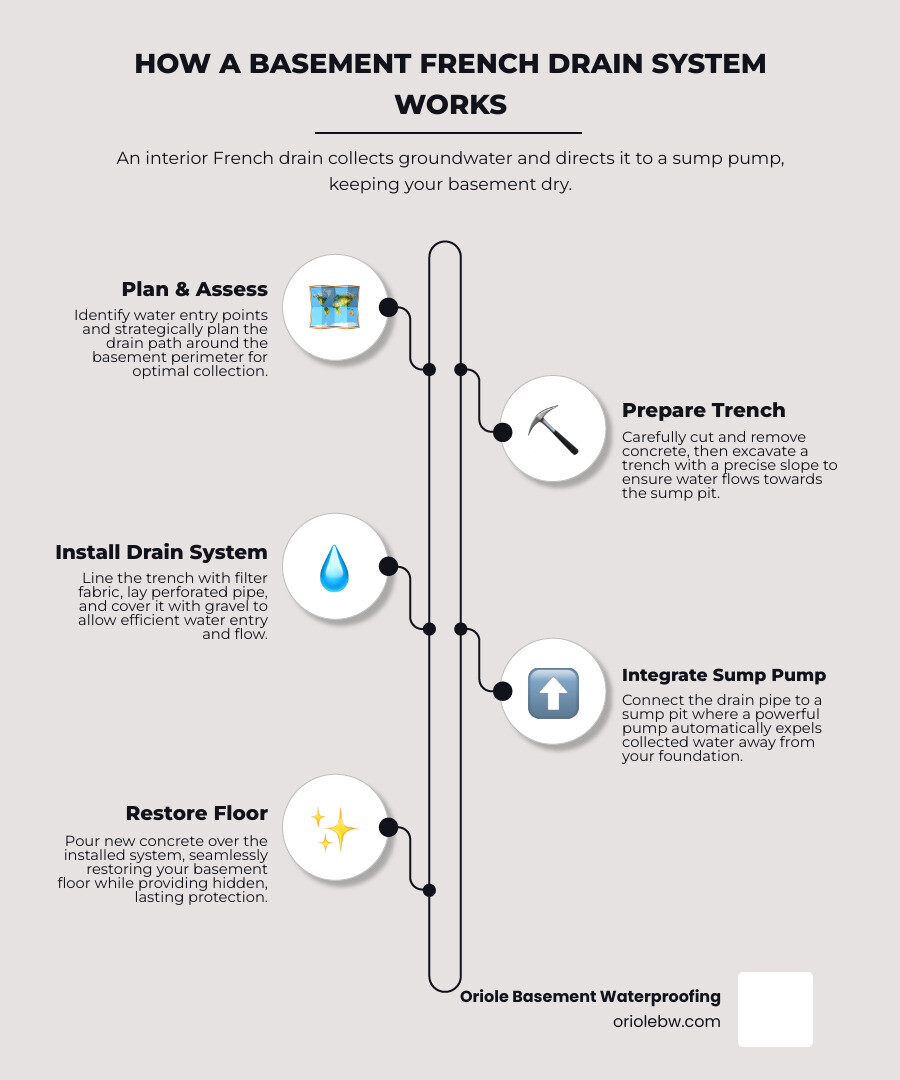
A basement French drain is a clever system designed to collect water that seeps through your foundation or rises from the ground. It works by relieving hydrostatic pressure-the force of groundwater pushing against your basement. We create a trench along the interior perimeter of your basement floor, placing a perforated pipe inside. This pipe is surrounded by gravel and wrapped in a filter fabric to prevent clogs. Water enters the pipe, flows by gravity to a sump basin, and is then automatically pumped out and away from your home. It’s a key component of a complete Basement Waterproofing strategy that protects your foundation from long-term water damage.
Telltale Signs Your Basement is Crying Out for Help
Your basement will often give you hints before a major flood occurs. We’ve helped countless homeowners in Baltimore City and Harford County spot these issues early. Look for:
- A persistent damp, musty smell: Often the first sign of mold or mildew fueled by moisture.
- Water stains or a white chalky powder (efflorescence): Clear evidence that water is passing through your concrete walls.
- Puddles on the floor: The most obvious sign that your basement’s defenses are failing.
- Peeling paint or damaged wallpaper: Moisture behind finished walls will cause coverings to fail.
- Visible mold or mildew spots: These growths thrive in damp environments and can pose health risks.
Ignoring these signs can lead to structural damage and poor air quality. If you see any of these, it’s time for a professional assessment. Our guide on 6 Signs You Need to Get Your Basement Waterproofed has more details.
The Anatomy of a Professional French Drain Installation
While the concept is simple, a professional installation is a precise operation. Our teams have refined this process over 70 years to ensure it’s both effective and long-lasting.
A professional job involves more than just digging a ditch. It starts with a thorough assessment to map out the optimal drain path. Then, we use specialized equipment to carefully cut and remove a section of the concrete floor. The trench is excavated to a precise, consistent slope-a critical detail that ensures water flows properly to the sump pump. A miscalculation here can render the entire system useless.
We use only professional-grade materials, including durable perforated pipe, clean drainage gravel, and a robust geotextile fabric that prevents sediment from clogging the system. The drain is seamlessly connected to a powerful sump pump, which is the heart of the system. After testing, we restore the concrete floor, leaving your basement clean and, most importantly, dry. This meticulous process, typically completed in one to two days, is why a professional installation is essential for lasting protection.
Interior vs. Exterior Drains: What’s the Right Call for Your Baltimore Home?
Homeowners often ask about interior versus exterior drains. Both are effective but serve different purposes. We offer both solutions across Baltimore City, Baltimore County, and Harford County, depending on the home’s specific needs.

Interior drains are installed under your basement floor to manage water that has already seeped through the walls or is coming up from below. They are less disruptive to your yard and can be installed year-round.
Exterior drains are installed outside along the foundation to stop water before it ever reaches your basement walls. This requires major excavation and is more expensive and disruptive to landscaping.
Here’s a quick comparison:
| Feature | Interior French Drain | Exterior French Drain |
|---|---|---|
| Location | Inside basement, under concrete floor | Outside home, along foundation footing |
| Primary Goal | Collects water that enters or rises in the basement | Intercepts water before it reaches the foundation |
| Landscape Impact | Minimal | High (extensive excavation) |
| Cost | Generally less expensive | Generally more expensive |
| Installation Time | Typically 1-2 days | Multiple days to a week or more |
| Disruption | Interior noise and dust, but minimal exterior impact | Major exterior disruption, heavy machinery |
| Best For | Existing finished basements, water seeping through walls/floor, year-round installation | New construction, severe exterior water issues, comprehensive foundation waterproofing |
For most existing homes with wet basements, an interior system is the most practical and effective solution. You can learn more about our Interior Drainage Systems and how we tailor them to each home.
Why a “DIY” French Drain Can Become a DIY Disaster
We get it. The satisfaction of a DIY project is hard to beat. But when it comes to installing french drain in basement, a DIY attempt can quickly turn into a costly disaster. This isn’t just a sales pitch; as a company that has served Baltimore City, Baltimore County, and Harford County for over 70 years, we’ve repaired countless failed DIY systems.
The Real Cost of a Botched Job vs. a Professional Guarantee

You might think you’re saving money, but the risks are enormous. Here’s where things go wrong:
- The Slope is Everything: The drainpipe needs a consistent, slight downward slope. If it’s off by even a fraction, water will pool in the trench instead of flowing to the pump, defeating the entire purpose. Maintaining this grade in a dusty trench is extremely difficult without experience and proper tools.
- Foundation Risk: You’re breaking concrete and digging right next to your home’s foundation footing. Dig too aggressively or in the wrong spot, and you can undermine the structural support of your house. We’ve seen DIY projects lead to foundation issues like bowing walls, which require far more expensive repairs like carbon fiber straps.
- Clogging: A professional installation uses a specific filter fabric, wrapped correctly to keep soil and sediment out. Without it, the system will clog with mud in a matter of months, becoming a useless, buried trench.
- Safety Hazards: Breaking concrete creates dust and debris, and there’s always a risk of hitting underground utility lines. You must Check state requirements before digging by calling 811, but accidents can still happen. A cut water main or electrical line is a dangerous and expensive mistake.
When we install your system, you get our lifetime transferable guarantee. If our work fails, we fix it. Period. A failed DIY project means you pay twice: once for your materials and time, and again for a professional to tear it out and do it right. The article Why is Basement Waterproofing Necessary? The Risks of Skipping It explains why getting it right the first time is so critical.
Your Peace of Mind: Maintenance, Lifespan, and Our Promise
A professionally installed French drain should last the lifetime of your home. We use high-quality materials and precise techniques to build systems that we installed 40 or 50 years ago that are still working perfectly today.
While the system is largely maintenance-free, we recommend a quick annual check. Pour a bucket of water into your sump pump basin to ensure it activates and pumps the water out. Also, check that the discharge line directs water at least ten feet from your foundation. The sump pump is the heart of the system, and it’s most vulnerable during storms when the power can go out. That’s why we strongly recommend Sump Pump Battery Backups to ensure your basement stays dry when you need it most.
Our promise is simple: When Oriole Basement Waterproofing installs your system, you get seven decades of local experience and a lifetime transferable guarantee that adds real value to your home. Don’t spend your weekends on a risky project that could fail. Let us give you a dry basement and peace of mind, guaranteed.