



What’s That Crack in My Wall?
Diagonal wall cracks can show up anywhere in your home, from the basement to an upstairs bedroom. Here’s what you need to know right away:
Quick Assessment Guide:
- Hairline cracks (thinner than 1/16 inch): Usually minor settling.
- Small diagonal cracks (1/16 to 1/8 inch): Monitor for growth.
- Wide diagonal cracks (over 1/4 inch): Call a professional.
- Cracks with other symptoms (sticking doors, sloping floors, water): Get an inspection now.
You’re hanging a picture and you spot it: a crack running at an angle across your wall. Your stomach drops a little. Was that always there?
It’s a question we hear all the time at Oriole Basement Waterproofing. After 70+ years working on local homes, we’ve seen thousands of wall cracks. Some are harmless, but others signal a foundation problem that needs attention. Diagonal cracks are often the most reliable sign your foundation is settling, typically starting at weak spots like the corners of doors and windows.
Not every crack means disaster. Homes settle, especially with the region’s clay soils. The key is knowing when a crack is normal aging and when it’s a warning sign. In this guide, we’ll give you straight talk on what causes these cracks, how to tell if yours is serious, and what to do next.
Decoding Diagonal Wall Cracks: What Your Home is Trying to Tell You
A diagonal wall crack isn’t just a cosmetic issue; it’s your house sending a message. These cracks rarely appear randomly. They are almost always a response to uneven forces pushing and pulling on your home’s structure, especially in drywall, plaster, and concrete.
You’ll often see them starting from the corners of doors or windows. These spots are natural weak points in your walls. When your foundation shifts, these vulnerable areas are the first to show the strain. The main causes are foundation settlement, soil pressure, and water problems. Understanding the cause is the first step toward a solution.

What Causes Diagonal Wall Cracks?
In our 70+ years of experience, we’ve found that diagonal wall cracks are the most reliable indicator of foundation settlement. Something underneath your home is moving. Here are the common culprits:
- Foundation Settlement: This is the main cause. When a home’s foundation sinks unevenly, known as differential settlement, it puts stress on the structure, creating diagonal cracks.
- Expansive Clay Soil: The region’s clay soil swells when wet and shrinks when dry. This constant push-and-pull can cause uneven settling and lead to cracks.
- Poor Drainage: Water pooling near your foundation from improper grading or clogged gutters creates hydrostatic pressure. This pressure can shift walls and cause cracking.
- Tree Roots: Large tree roots near your home can draw moisture from the soil, causing it to shrink and settle. They can also physically push against the foundation.
- Improper Construction: Weak footings or a poorly constructed foundation can create a structural weakness that leads to settlement and cracks over time.
These cracks are symptoms of a deeper issue. If you’re seeing them, our guide on what to do if foundation needs repair can help you understand the next steps.
How to Tell a Serious Crack from a Minor One
Not every crack means your foundation is failing. The key is to look at the crack’s size, location, and any other symptoms.
Crack width is your first clue. A hairline crack (thinner than 1/16 inch) is usually cosmetic. But if a diagonal wall crack is 1/4 inch or wider, or if it’s actively growing, it’s a sign of a bigger problem.
Location matters. Cracks starting at the corners of doors and windows are concerning because these are natural stress points.
Here’s a quick comparison:
| Sign | Cosmetic Crack | Structural Crack |
|---|---|---|
| Crack Width | Hairline (< 1/16 inch) | Wider than 1/4 inch, or actively growing |
| Crack Location | Random spots, often at drywall seams | Corners of doors/windows, load-bearing walls, foundation |
| Growth/Movement | Stays the same over time | Widening, lengthening, or comes back after patching |
| Sticking Doors/Windows | No | Yes, suddenly hard to open or close |
| Sloping Floors | No | Yes, noticeable unevenness |
| Gaps in Walls/Ceilings | No | Yes, separation visible where walls meet ceiling or floor |
| Water Intrusion | No | Yes, dampness, stains, or active leaks |
| Multiple Cracks | Isolated | Cluster of cracks in one area |
If you see other signs like sticking doors, sloping floors, or gaps where walls meet the ceiling, your foundation is likely shifting. Water intrusion through a crack is another major red flag that requires immediate attention. When you see multiple warning signs together, it’s time to call a professional.
Diagonal vs. Other Types of Wall Cracks
Different crack patterns tell different stories. Here’s a quick guide:
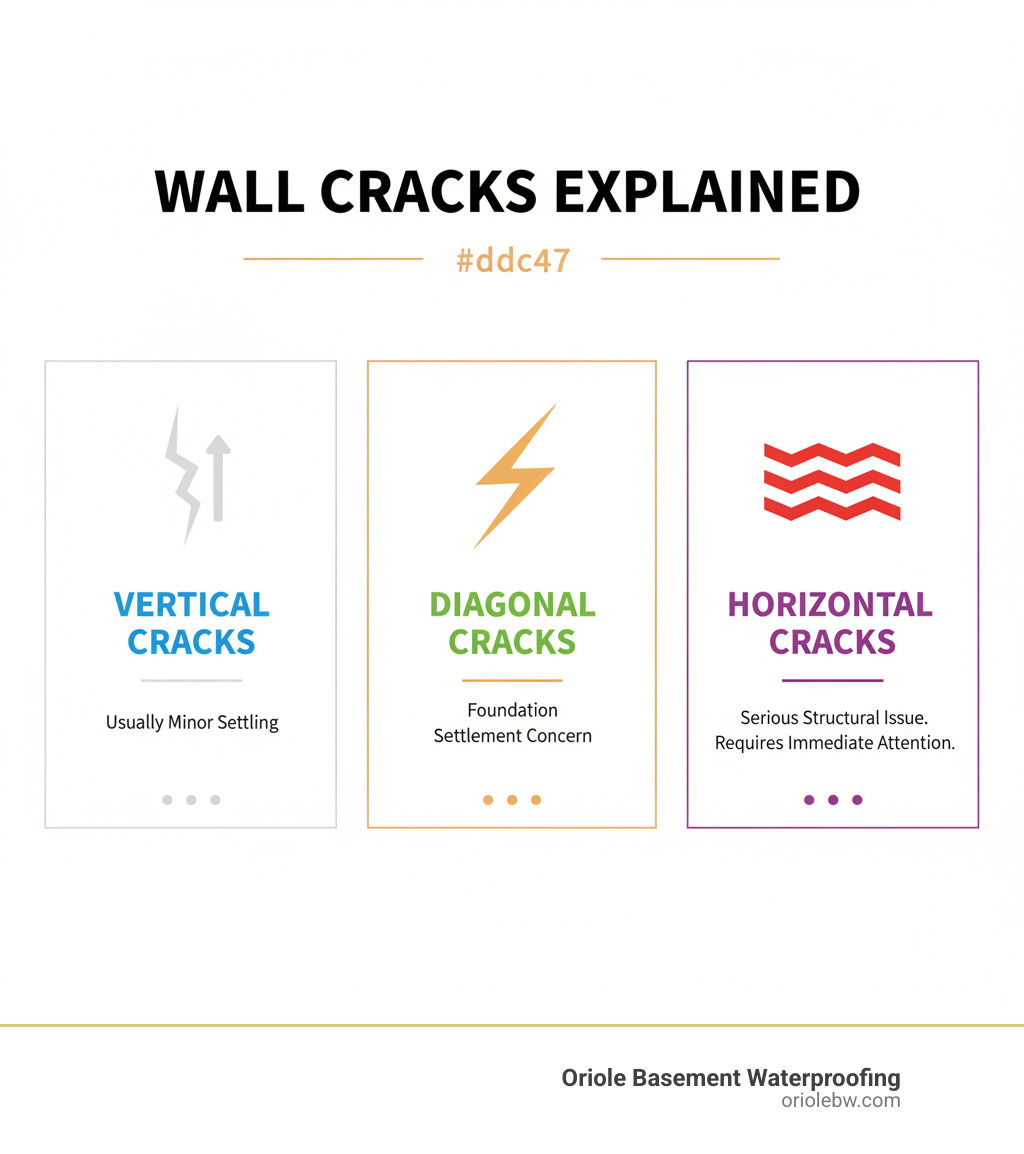
- Vertical Cracks: Often caused by minor settling. They are generally less concerning unless they are wide (over 1/8 inch) or leaking water.
- Horizontal Cracks: These are serious. They typically appear in basement walls and indicate intense soil pressure pushing the wall inward. This requires immediate professional attention.
- Stair-Step Cracks: Found in brick or block walls, these follow the mortar joints. Like diagonal cracks, they are a strong sign of foundation settlement.
- Hairline Cracks: Very thin cracks (less than 1/16 inch) are usually cosmetic but should be monitored to ensure they don’t grow.
While you might monitor a hairline crack, diagonal, horizontal, and stair-step cracks almost always warrant a professional inspection. Understanding the cause is key to a lasting repair. For more on this, see our guide on fixing basement cracks.

The Risks of Ignoring Those Diagonal Wall Cracks
It’s tempting to paint over a crack and hope it goes away. But after 70+ years of fixing local foundations, we’ve seen that waiting only makes things worse. Ignoring a diagonal wall crack can lead to:
- Worsening Structural Damage: A small crack can grow, leading to bowed walls, sagging floors, and more extensive structural problems.
- Higher Repair Costs: What might be a straightforward fix today could become a major, expensive repair down the road. Addressing issues early is why basement waterproofing is necessary to protect your wallet.
- Decreased Property Value: Foundation problems must be disclosed when you sell, which can scare off buyers and lower your home’s value.
- Water Intrusion and Mold: Cracks are an open door for water, leading to a damp basement, damaged belongings, and potential mold growth. Water issues can cause further moisture damage. While we refer mold remediation to our partners at Raven Mold, we fix the water problem that causes it.
Ignoring a crack isn’t just about looks; it’s about protecting your home, your investment, and your family.
Your Next Steps: From Monitoring to Professional Repair
Now that you’ve spotted a diagonal wall crack, what’s next? The right approach is to understand what you’re dealing with and take action. Some cracks can be monitored, while others need immediate professional attention.
At Oriole Basement Waterproofing, our approach is to find the root cause and fix it for good, backed by our lifetime warranty. We don’t do quick patches; we provide long-term solutions to keep your foundation strong and your basement dry.

When to Monitor vs. When to Call a Pro
Deciding whether to monitor a crack or call a professional depends on what you see.
You can monitor the crack if:
- It’s a hairline crack (thinner than 1/16 inch).
- There are no other symptoms like sticking doors, sloping floors, or water.
To monitor it, mark the ends with a pencil and date, then take a photo for reference. Check it every few months. If it grows, it’s time to call us.
You should call a professional immediately if:
- The diagonal wall crack is 1/4 inch wide or wider.
- The crack is actively growing in length or width.
- You see any signs of water, dampness, or staining around the crack.
- You notice other symptoms like sticking doors, sloping floors, or gaps between walls and ceilings.
When in doubt, call for an inspection. Peace of mind is valuable. Our foundation repair guide for Baltimore offers more local information for homeowners in Baltimore City, Baltimore County, and Harford County.
What a Professional Foundation Repair Looks Like
When you call Oriole, you’re getting a team that has been solving local foundation problems since the 1950s. We don’t just patch cracks; we provide permanent, engineered solutions.
Our process includes:
- A Free, Comprehensive Inspection: Our certified technician assesses your entire foundation, drainage, and structure to find the root cause of the diagonal wall crack, not just the symptom.
- Engineering-Backed Solutions: For major repairs, we partner with structural engineers to ensure the solution is sound and built to last. This is why we can offer a lifetime warranty.
- Customized Repairs: We design a solution for your specific home. This may include carbon fiber straps to stabilize bowing walls or structural repairs like sill plate, support beam, or floor joist replacement to restore your home’s integrity.
- Holistic Water Management: Since water and foundation issues are linked, we often recommend drainage solutions like interior drainage systems or sump pumps to keep your basement dry.
We back our foundation repairs with a lifetime transferable warranty. We’re locals who understand our local soil and weather, and we’re committed to getting the job right.
Ready to get those diagonal wall cracks properly assessed and fixed? Get your free inspection for foundation cracks today. Let’s build you a foundation you can count on for decades to come.