



Why Your Baltimore Basement Has a Water Problem (And What to Do About It)
Baltimore City underground streams and basement waterproofing go hand in hand. Our city sits on one of the most complex underground water systems on the East Coast. If you have water in your basement, you’re not alone, and there’s a good reason for it.
Quick Answer: Baltimore’s Water Problem
- Underground streams flow beneath the city, creating constant hydrostatic pressure.
- Sassafras soil (Maryland’s state soil) expands and contracts with moisture.
- Older foundations (pre-1950s) weren’t built for today’s water challenges.
- A high water table means groundwater sits close to your basement floor.
- Heavy rainfall overwhelms aging drainage systems.
Here’s what most Baltimore homeowners don’t realize: basement water seepage isn’t just about proximity to the harbor. Our research shows that homes throughout Baltimore City, from Federal Hill to North Baltimore, deal with water issues because of what’s happening underneath the ground.
The problem starts with hydrostatic pressure, which is water in the soil pushing against your foundation. Think of it like water weighing about 60 pounds per cubic foot, constantly pressing on your basement. Add Baltimore’s clay-heavy Sassafras soil that holds water like a sponge, and you have a recipe for a wet basement.
Many people try the obvious fixes first: cleaning gutters, extending downspouts, and fixing yard grading. These help, but they’re often not enough. Baltimore’s underground water network doesn’t care if your gutters are perfect; it will find a way into your basement. We’ve been fixing Baltimore basements for over 70 years, and the good news is that every water problem has a solution once you understand the real cause.
The Unseen Enemy: How Baltimore’s Geology and History Cause Wet Basements
After fixing basements in the area for over 70 years, we’ve learned that Baltimore city underground streams and basement waterproofing problems affect everyone. The water finds a way in because of what’s happening beneath your feet.
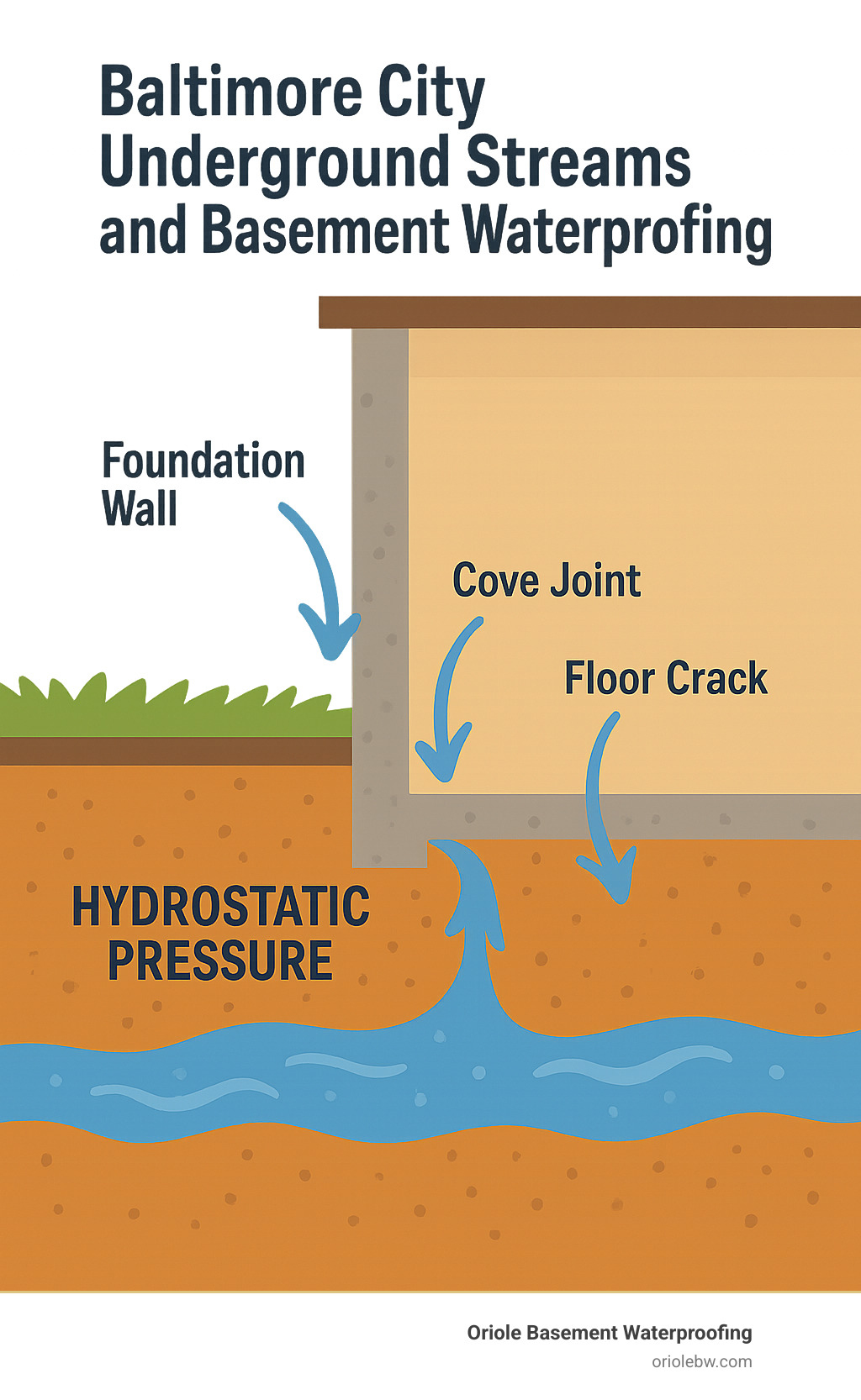
Baltimore sits on a challenging underground water network. We’re talking about hidden streams flowing beneath the city that create constant pressure against your foundation. These streams don’t show up on maps, but they’re always moving water through the soil, creating what we call hydrostatic pressure that pushes against your basement walls 24/7.
Baltimore’s foundation age also plays a huge role. Homes in neighborhoods like Federal Hill or Fells Point were built in the 1800s and early 1900s with porous concrete and basic construction methods not designed for modern water challenges.
Our city’s yard slope and topography can make things worse. Natural hills and valleys create water collection points. If your yard slopes toward your house, every rainstorm directs water right into the soil surrounding your basement.
The real troublemaker, though, is Maryland’s state soil: Sassafras soil. This soil contains clay, which expands when wet and shrinks when dry. This constant push-and-pull cycle creates cracks and weak spots in your foundation that become highways for water.
We’ve seen this combination of factors create basement water problems in homes throughout Baltimore City and Baltimore County. Understanding these underlying causes is the first step to finding the right solution. For more information, check out our guide on Water in Foundation: How to Protect Maryland Homes.
Understanding Hydrostatic Pressure and the Cove Joint
Let’s talk about hydrostatic pressure, the invisible force causing your basement headaches. Water weighs about 62 pounds per cubic foot. When groundwater levels rise around your home, all that weight pushes against your foundation walls and floor.
This pressure is relentless and always looks for the weakest spot. That’s often the cove joint, the seam where your basement floor meets the foundation wall. In older Baltimore homes, this joint is a common failure point. When hydrostatic pressure builds, water gets forced up through this joint. You might see water appearing along the edges of your basement floor, especially after heavy rains.
Signs of Water Intrusion vs. Condensation
Homeowners often ask, “Is this water coming through my foundation, or is my basement just sweating?” It’s a great question because the solutions are completely different.
Active water seepage means water is traveling through your foundation. You’ll see damp spots after rain, peeling paint, and white, chalky deposits called efflorescence. Wall and floor cracks are common entry points, along with that telltale musty odor.
Condensation happens when humid air hits cool basement surfaces. You’ll see uniform dampness on walls, pipes, and floors, especially during humid summer months.
| Sign / Symptom | Active Seepage (Water Intrusion) | Condensation (‘Sweating’) |
|---|---|---|
| Source of Moisture | Water actively coming through foundation from outside | Moisture in the air condensing on cooler surfaces |
| Appearance | Wet spots, puddles, streaks, efflorescence, bubbling paint | Uniform dampness, sweating surfaces, musty odor without visible leaks |
| Location | Often concentrated near cracks, cove joints, or utility penetrations | Tends to be widespread on walls, floors, pipes, and cold surfaces |
| Timing | Appears after rain, snowmelt, or prolonged wet periods | More common during humid summer months, regardless of recent rain |
This distinction matters because condensation might need a dehumidifier, while active seepage requires professional waterproofing. Misdiagnosing the problem can lead to wasting money on the wrong solution.
Your First Line of Defense: Simple Fixes That Can Make a Big Difference
When we visit a Baltimore home, we always start by assessing the basics. Many baltimore city underground streams and basement waterproofing problems are made worse because water isn’t managed properly at ground level. These surface-level issues are a home’s first line of defense, but addressing them is often not a complete solution.
Clogged gutters, for example, can dump thousands of gallons of water right next to a foundation. We’ve seen homes where simply addressing the gutters significantly reduced basement dampness.
Downspouts that don’t carry water at least 5-6 feet away from the house can also be a major contributor. A downspout that dumps water at the foundation is like pointing a hose at the basement wall during every storm.
Proper yard grading is also critical. The ground around a house should slope away from the foundation to direct water flow away from the basement.
Even a clogged basement stairwell drain can cause a basement to flood. Similarly, visible cracks in foundation walls can serve as direct entry points for water.
The Baltimore Office of Sustainability offers good guidance on these measures. If you’re seeing warning signs, our guide on 6 Signs You Need to Get Your Basement Waterproofed can help you decide if it’s time to go beyond these basic checks.
Why Gutters and Grading Aren’t Always Enough for Baltimore Homes
Here’s what we’ve learned after 70 years working in Baltimore City, Baltimore County, and Harford County: perfect gutters and grading are necessary, but they’re often not enough.
Heavy rainfall in Maryland can overwhelm even the best surface drainage systems. That clay-heavy Sassafras soil acts like a sponge, holding water long after a storm. Once it’s saturated, the water has nowhere to go but sideways, pushing against your foundation.
In many parts of Baltimore, the high water table means groundwater is already sitting close to your basement floor. No amount of gutter cleaning can change this.
The real challenge is the persistent hydrostatic pressure from underground streams. This water doesn’t care about your gutters or yard slope. It will find the weakest point in your foundation and push its way through.
Surface-level solutions handle the water you can see. However, Baltimore city underground streams and basement waterproofing issues require addressing the water you can’t see. That’s when professional, comprehensive solutions become necessary.
Professional Solutions for Baltimore City Underground Streams and Basement Waterproofing
When simple fixes aren’t enough, it’s time for professional solutions. Ignoring basement water can lead to serious structural damage and health issues from mold and mildew. Waterproofing your basement isn’t just about keeping it dry; it’s about protecting your biggest investment and ensuring a healthy living environment. We believe Baltimore city underground streams and basement waterproofing requires a holistic approach that assesses your entire property. Learn more here: Why Basement Waterproofing is Necessary: The Risks of Skipping It.
Protecting Your Home’s Bones: Foundation Repair
Over time, water can wreak havoc on your home’s foundation, causing it to settle, crack, or bow. We specialize in comprehensive foundation repair to keep your home’s structure strong.
Our services include:
- Sill Plate Replacement: The sill plate is the wooden beam on top of your foundation. If it rots from moisture, it compromises your home’s structure. We replace damaged sill plates to restore stability.
- Support Beam and Lolli Column Replacement: These critical supports can weaken from water damage, leading to sagging floors. We replace them to ensure your home is properly supported.
- Floor Joist Replacement: Water-damaged floor joists can lead to soft or uneven floors. Our team replaces them to restore the strength of your floors.
- Sub Floor Replacement: We can replace a moisture-damaged subfloor to eliminate mold issues and prepare the area for new flooring.
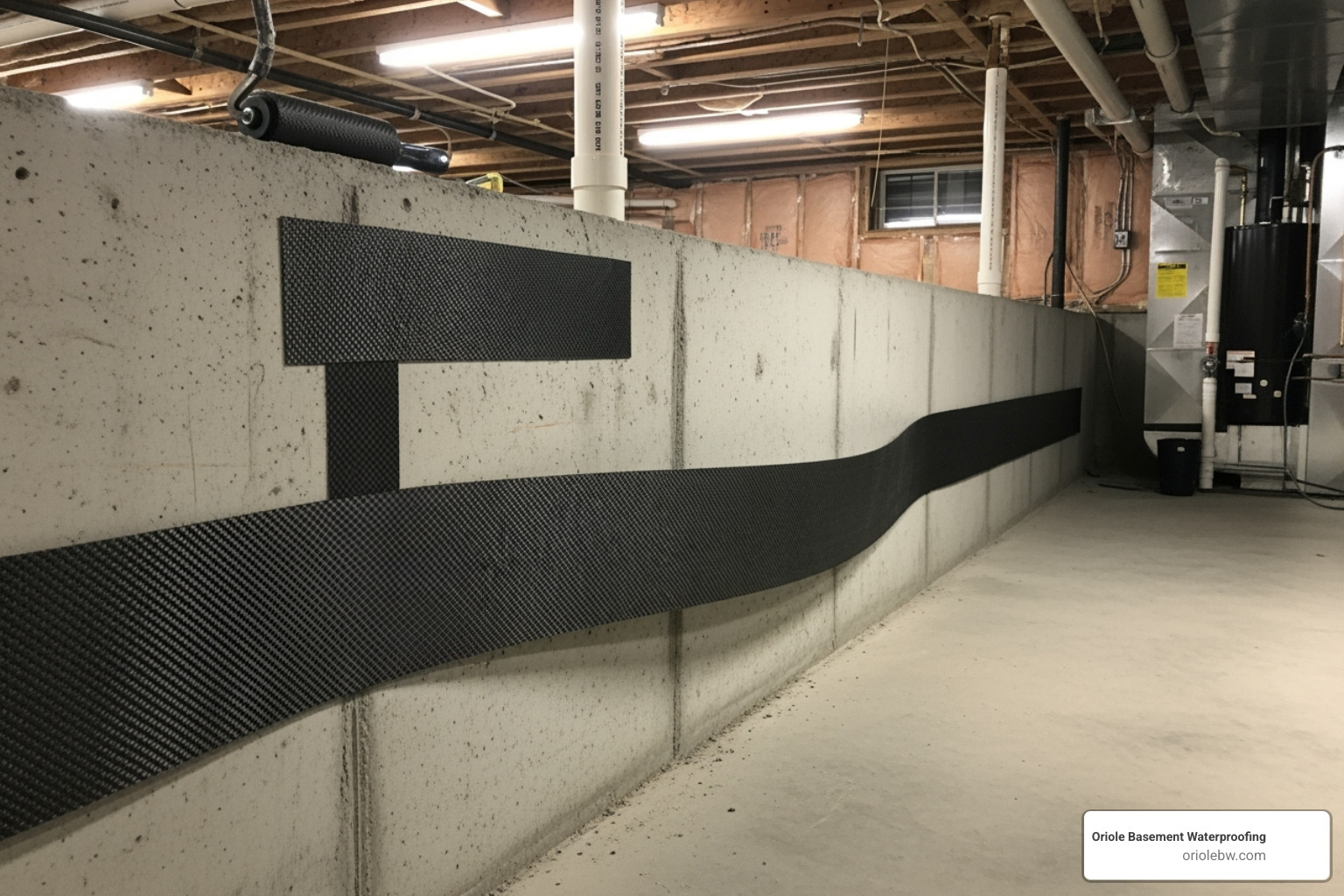
- Carbon Fiber Straps for Bowing Walls: Hydrostatic pressure can cause foundation walls to bow inward. We use strong carbon fiber straps to reinforce these walls and prevent further movement.
Addressing these issues promptly is crucial. For more details, explore our Foundation Repair services.
Sealing the Ground Floor: Crawl Space Encapsulation
Many Baltimore homes have damp crawl spaces that are a major source of humidity, musty odors, and high energy bills. This moisture creates the perfect conditions for mold growth, which can impact your home’s air quality.
Our crawl space encapsulation services transform these areas into clean, dry environments. This involves:
- Vapor Barrier Installation: We install heavy-duty vapor barriers on the floor and walls to isolate the crawl space from ground moisture.
- Dehumidifier Integration: We can integrate powerful dehumidifiers to control airborne moisture and keep humidity levels low.
- Insulation: Properly insulating your crawl space helps maintain stable temperatures and reduces energy loss.
If significant mold is present, we may recommend a professional mold remediation company, unless the mold is directly linked to an active water intrusion issue we are addressing. Preventing moisture is the best long-term strategy. Learn more about our solutions: Crawl Space Encapsulation.
Managing the Unstoppable: Interior Drainage and Sump Pumps
For persistent water issues driven by high water tables or Baltimore city underground streams and basement waterproofing challenges, interior drainage systems are the most effective solution. We can’t stop groundwater, but we can manage it.
- Interior Drain Tile: This system collects water seeping through the walls or up from the floor and directs it to a sump pit before it can cause damage.
- Sump Pump Systems: The sump pump is the heart of the system. It automatically activates to eject water safely away from your home.
- Battery Backups: A battery backup for your sump pump is a non-negotiable safeguard. It ensures your pump works during power outages, which often happen during the worst storms.
These systems provide robust protection against water intrusion. Explore our Wet Basement Repair Expert Solutions.
Finding a Trusted Local Expert for Your Basement
When your basement has water damage, you need a contractor who understands Baltimore’s unique challenges. Baltimore city underground streams and basement waterproofing solutions require someone who truly knows our area. This is the difference between a fix that lasts and one that fails.
After more than 70 years serving families throughout Baltimore City, Baltimore County, and Harford County, we’ve learned that trust is earned through results and honesty. When you call us, you get a no-pressure inspection from someone who has seen every type of foundation issue our area can throw at a home.
Our approach is different because we focus on engineering-backed solutions. For major foundation repairs, we partner with structural engineers to ensure we’re solving the problem permanently. That’s why we offer lifetime transferable warranties on our work. We stand behind what we do because we know it works.
We use our own certified crews, not subcontractors. Every technician is trained specifically on Baltimore-area soil conditions and the challenges of working on everything from century-old rowhouses in Fells Point to newer homes.
For more information about our approach, visit our Basement Waterproofing Company Baltimore page.
Key questions for a waterproofing contractor for Baltimore city underground streams and basement waterproofing
Before hiring anyone, ask the right questions. We encourage you to interview multiple contractors.
- How long have you been working specifically in the Baltimore area? Our region’s underground streams, clay soil, and older homes create unique challenges.
- How do you manage hydrostatic pressure? This is a key question. The answer shouldn’t be waterproofing paint.
- What does your warranty actually cover? Our lifetime transferable guarantees cover materials and labor and transfer to new homeowners.
- Do you use your own crews or subcontractors? We use our own trained employees to ensure consistent quality.
- Can you provide local references? We’re proud to share references from your neighbors in Baltimore City, Baltimore County, and Harford County.
- What is your assessment process? A comprehensive approach looks at the entire property, not just the wet spots.
The risks of DIY vs. professional solutions for Baltimore city underground streams and basement waterproofing
We get it, DIY seems tempting. But for Baltimore city underground streams and basement waterproofing, a DIY approach often creates more problems than it solves.
The biggest risk is structural damage. A simple crack repair might mask a serious foundation issue. We’ve seen homeowners try to fix things themselves, only to need extensive foundation repairs later.
Improper installation is another major concern. An incorrectly installed drainage system can make your water problems worse. There’s also the safety factor of working in tight spaces with electrical components.
Code violations are a real risk. An improper system could fail a home inspection when you decide to sell.
The most frustrating outcome is wasted money. Homeowners spend hundreds or thousands on materials, only to have the problem persist. Then they call us, paying twice for the same solution. While basic maintenance is fine for DIY, dealing with hydrostatic pressure and foundation integrity requires professional expertise to protect your home.
Keep Your Baltimore Basement Dry for Good

After 70 years of helping Baltimore families, we know that Baltimore city underground streams and basement waterproofing isn’t just about fixing a leak. It’s about understanding that your home sits on a complex underground water system and working with that reality.
Those underground streams and the clay-heavy Sassafras soil aren’t going anywhere. The hydrostatic pressure against your foundation is constant. What can change is how well your home is prepared to handle these forces.
We’ve walked you through Baltimore’s unique water challenges, from historic rowhouses in Federal Hill to homes in Baltimore County struggling with our soil and high water table. Surface fixes like gutter maintenance and proper grading are essential first steps, but they are often not enough against the relentless force of groundwater.
That’s where our holistic approach makes the difference. We don’t just patch a crack. We look at your home’s foundation integrity, assess your crawl space, and design interior drainage systems that work. Our engineering-backed solutions and lifetime transferable guarantees are our promise that you won’t be chasing the same water problem year after year.
Whether it’s carbon fiber straps for a bowing wall, a complete crawl space encapsulation, or an interior drain tile system with a battery backup sump pump, every solution is designed to protect your investment for decades.
The families we’ve helped in Baltimore City, Baltimore County, and Harford County all started where you are now: frustrated with a wet basement. Today, they’re using their basements without a second thought about water damage.
Your basement doesn’t have to be a source of stress. With the right professional approach, it can become the dry, healthy, worry-free space you’ve always wanted. We’re here to make that happen.
Ready to finally win the battle against basement water? Get your free inspection and learn about our sump pump and battery backup systems. Let’s turn your basement into the asset it was meant to be.