



Why Crawl Space Encapsulation Systems Are Essential for Maryland Homes
Crawl space encapsulation systems are comprehensive moisture control solutions that seal your crawl space from outside air and ground moisture, creating a dry, healthy environment beneath your home.
Key Components of Crawl Space Encapsulation Systems:
- Heavy-duty vapor barrier (20+ mil thickness) covering floors and walls
- Sealed vents and air leaks to prevent outside moisture infiltration
- Dehumidification system to control humidity levels
- Insulation on walls rather than between floor joists
- Drainage systems when groundwater is present
Here in Maryland and Pennsylvania, we see it all the time. One day you notice that musty smell coming from somewhere in your house. Maybe your energy bills keep climbing, or your floors feel cold no matter how high you crank the heat. Often, the culprit is lurking right beneath your feet.
Traditional vented crawl spaces were designed with good intentions – let air flow through to “dry things out.” But in our humid Mid-Atlantic climate, that approach backfires. Instead of drying, those vents invite moisture, pests, and problems that can affect your entire home.
The research is clear: up to 60% of the air in your home comes from the crawl space. When that space is damp, moldy, or pest-infested, you’re breathing those problems upstairs. That’s where crawl space encapsulation systems make all the difference.
At Oriole Basement Waterproofing, we’ve spent over 70 years helping Maryland and Pennsylvania homeowners transform problematic crawl spaces into clean, dry assets. We’ve seen how the right encapsulation system doesn’t just solve moisture problems – it creates healthier homes and saves money on energy costs.
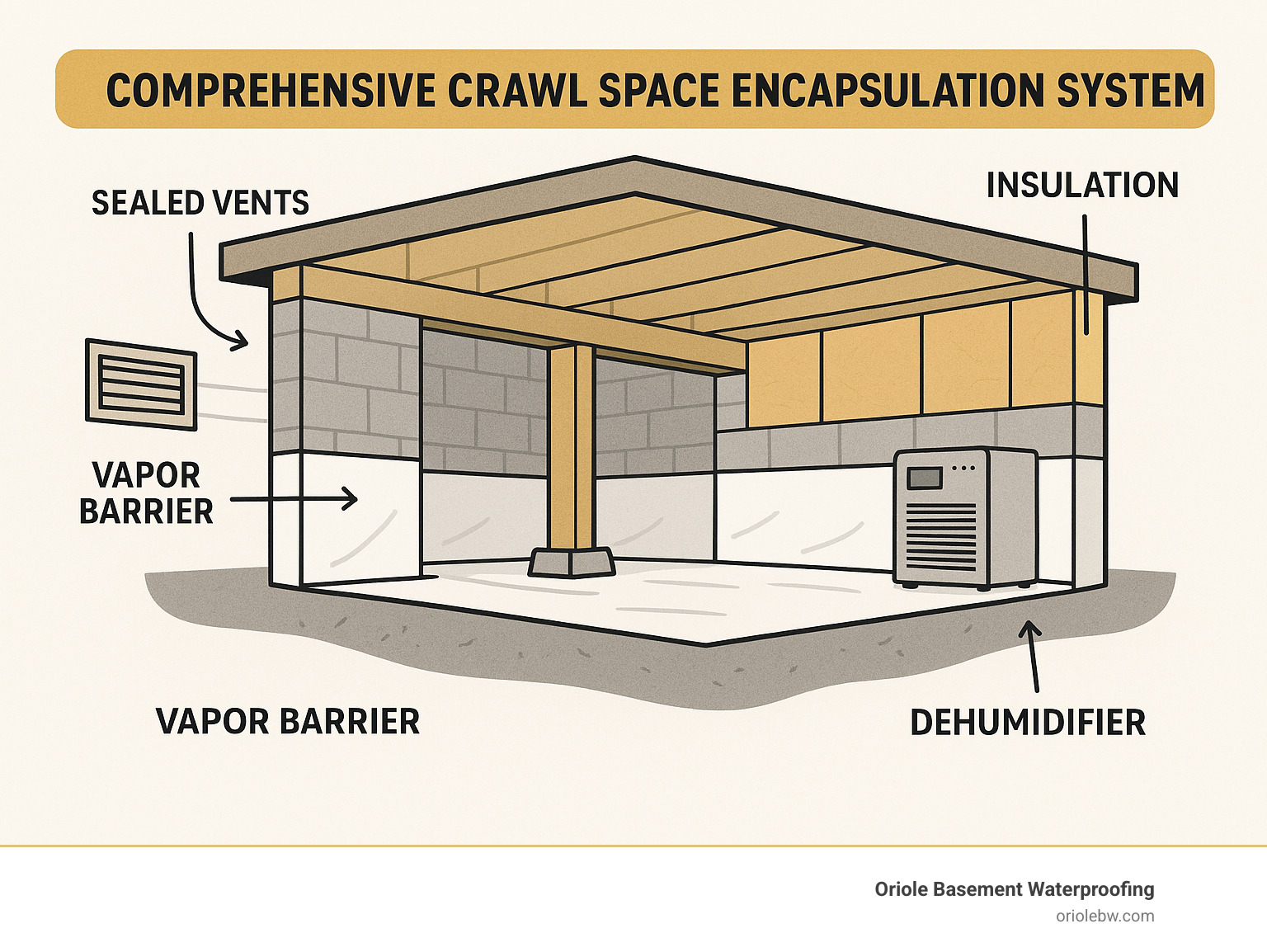
The Problem Under Your Feet: Why Traditional Vented Crawl Spaces Fail
For years, building codes allowed vented crawl spaces, thinking air circulation would keep them dry. In humid regions like Maryland and Pennsylvania, this approach backfires. Open vents don’t dry the space; they invite moisture, humidity, and even standing water under your home.
This constant moisture creates a perfect storm for a host of problems:
- Humidity: Warm, humid outside air condenses on cooler surfaces in the crawl space, leading to dampness and higher energy bills.
- Energy Loss: Vented crawl spaces let in cold winter drafts and hot summer air, forcing your HVAC system to work overtime and increasing your heating and cooling costs.
- Pest Infestations: Pests like mice, snakes, and spiders love the moist, dark environment of a dirt crawl space, using it as a breeding ground and a highway into your home.
- Structural Damage: Wooden joists and beams can get wet and rot, leading to sagging floors and compromising your home’s structural integrity.
- Poor Air Quality: Moisture in dirt crawl spaces can cause serious air quality issues, as mold spores travel upwards into your living space, potentially leading to health issues.
Common Signs You Have a Crawl Space Problem
How do you know if your crawl space is causing problems? Your home has ways of telling you. Here are some common signs:
- Musty Smells: A persistent damp or earthy odor, especially on the first floor, often signals mold or mildew.
- High Energy Bills: Unusually high heating and cooling costs can mean your crawl space is leaking conditioned air or letting unconditioned air in.
- Cold Floors: In winter, floors above an unconditioned crawl space often feel noticeably cold.
- Pest Sightings: An increase in pests like cockroaches, spiders, or rodents can often be traced to a damp crawl space.
- Wood Rot: Visible decay or fungus on floor joists and support beams within the crawl space.
- Drywall Cracks: Cracks in interior drywall, especially near doors or windows, can point to structural issues from a compromised crawl space.
- Uneven Floors: Sagging or uneven floors are a serious sign that the wooden supports in your crawl space may be rotting.
- Heightened Allergies or Asthma Symptoms: Mold spores and dust mites from a damp crawl space can significantly worsen respiratory conditions.
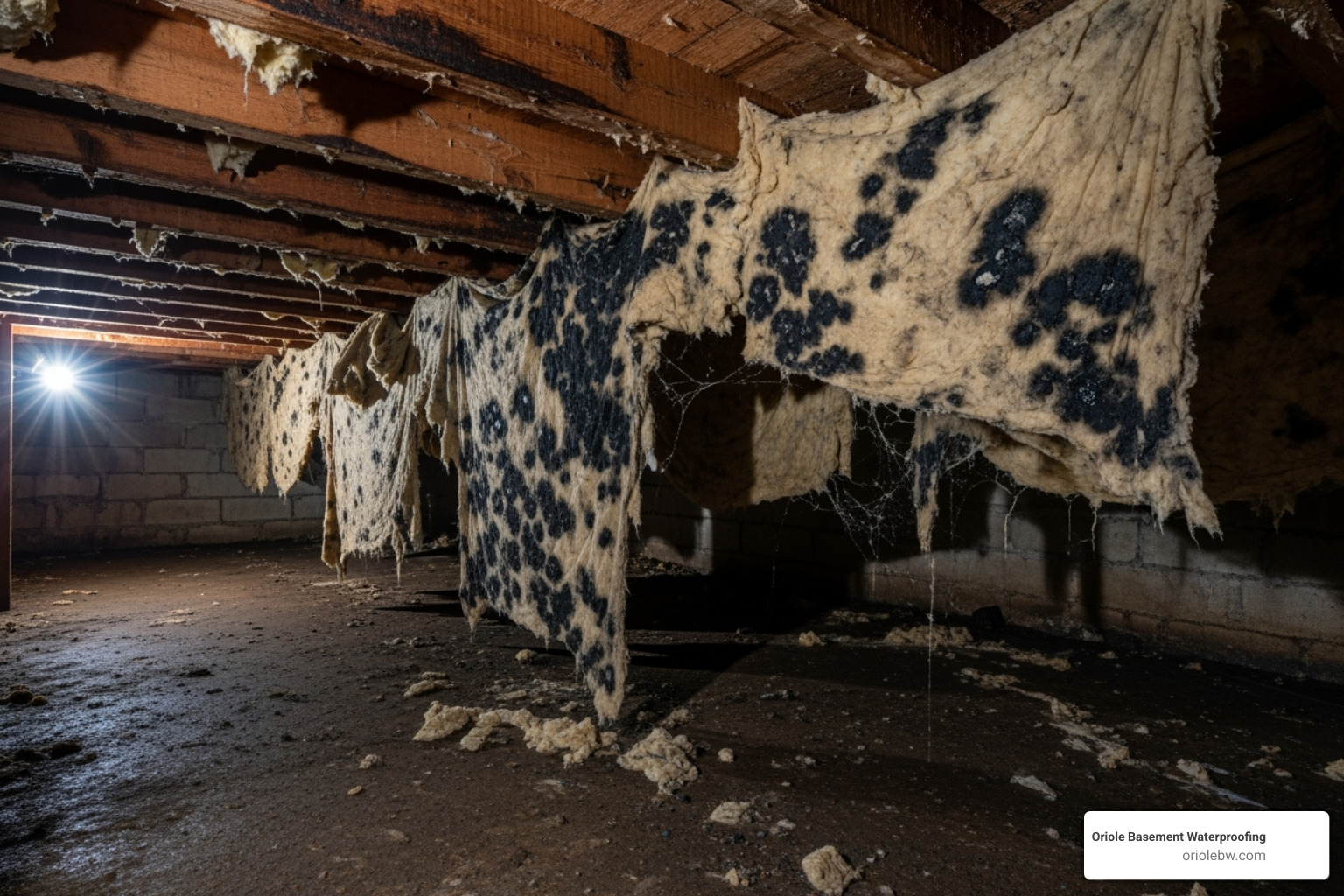
A common sight: moldy, sagging fiberglass insulation, a clear sign of moisture problems in the crawl space.
If you’ve noticed any of these symptoms, it’s a good idea to have your crawl space professionally inspected. Ignoring them can lead to more extensive and costly repairs.
What is Crawl Space Encapsulation? A Complete Overview
Think of crawl space encapsulation as a complete makeover for your home’s foundation. Instead of leaving that dark, damp space vulnerable to moisture and pests, we transform it into a clean, dry, controlled environment that benefits your entire home.
In Maryland and Pennsylvania, we’ve seen too many homeowners take an “out of sight, out of mind” approach to their crawl spaces. But what happens under your house doesn’t stay there. A properly encapsulated crawl space becomes part of your home’s healthy living environment, not a source of problems.
Crawl space encapsulation systems work by completely sealing your crawl space from the earth and outside air. This isn’t just throwing a tarp over the dirt. It’s a comprehensive process that addresses every source of moisture and every air leak.
The beauty of encapsulation is that it turns an unusable, problematic space into a clean, dry area that adds value to your home. Many of our customers in Baltimore County and Lancaster County are amazed at how their encapsulated crawl spaces look like actual rooms: bright, clean, and even suitable for storage.
This holistic approach means we’re not just preventing moisture problems; we’re creating a healthier home, improving energy efficiency, and giving you peace of mind.
The Typical Encapsulation Process: From Damp to Dry
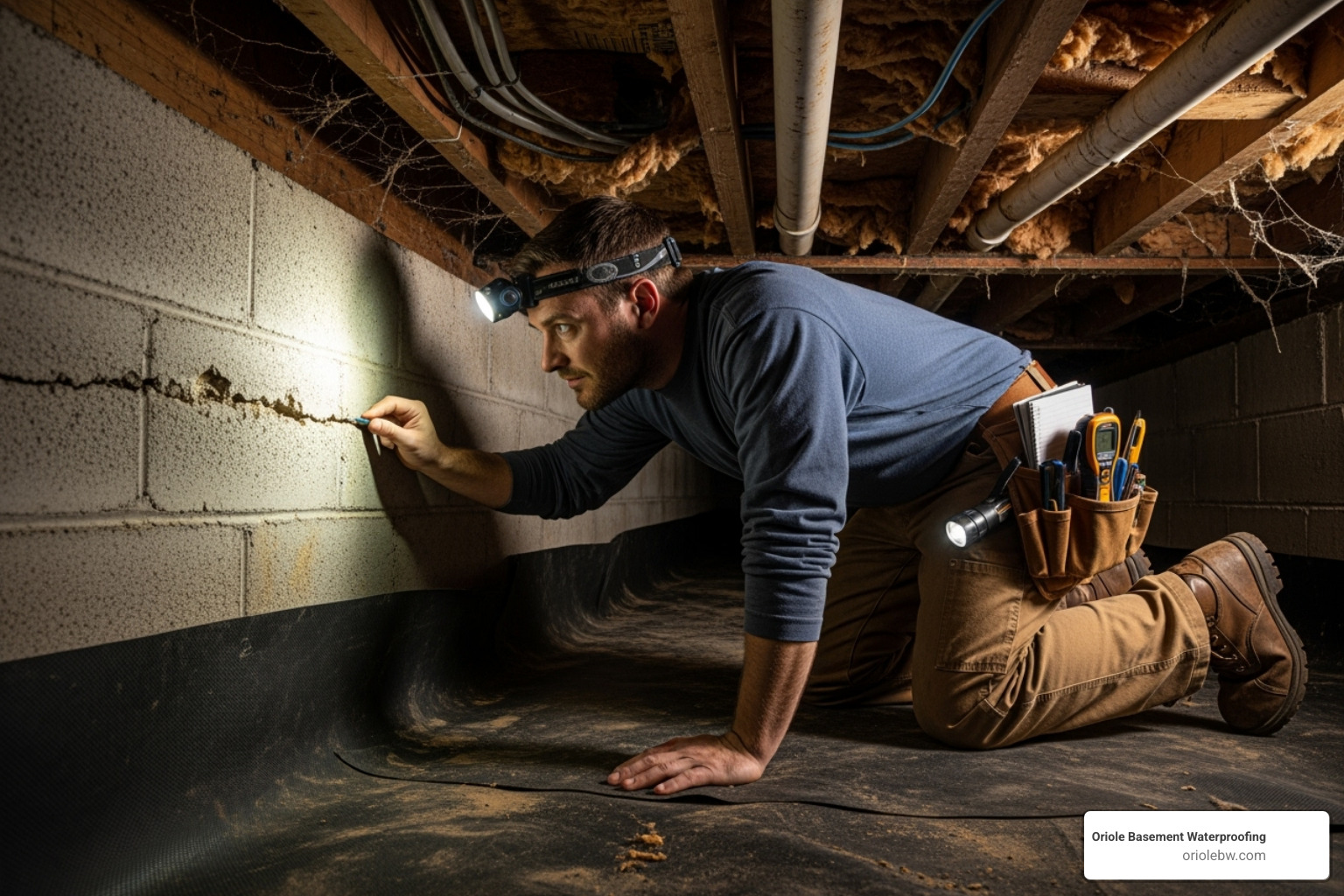
Every successful encapsulation project starts with a thorough inspection. We look for moisture sources, check for structural issues, and identify any mold or pest problems that need addressing before we seal the space.
The cleaning and preparation phase starts the change. We remove soggy fiberglass insulation, debris, and moisture-damaged materials. If we find mold without active water intrusion, we partner with Raven Mold for remediation. If water and mold are present, we handle both.
Next, we tackle any groundwater issues. In areas like Anne Arundel County where groundwater is common, we often install interior drainage systems to collect water and direct it to a sump pump. This step is crucial for keeping the space dry from below.
The heart of the process is installing the vapor barrier, a heavy-duty polyethylene membrane that covers the entire crawl space floor and extends up the foundation walls. We use professional-grade material, typically 20 mil thick, with all seams carefully sealed to stop ground moisture from evaporating into the space.
Sealing vents and air leaks comes next. Foundation vents are permanently sealed with durable covers, and every gap, crack, or opening is sealed to keep humid outside air out.
Even in a sealed space, some moisture can enter. That’s why we install a specialized crawl space dehumidifier to maintain optimal humidity levels year-round. These are powerful, energy-efficient systems designed specifically for this application.
Our final inspection ensures every component is working together correctly. When we’re done, you’ll have a crawl space that’s not just dry, but actively contributing to your home’s health and efficiency.
The Anatomy of a Modern Crawl Space Encapsulation System
A true crawl space encapsulation system is more than just a plastic sheet on the ground. It’s an integrated system where every component works together to keep your crawl space dry. With our decades of experience, we know a holistic approach is key for long-term moisture and air quality control that protects your entire home.
The Role of the Vapor Barrier
The vapor barrier is the hero of your crawl space encapsulation system. This isn’t flimsy plastic from a hardware store. We use heavy-duty, reinforced polyethylene that’s built to last for decades.
The vapor barriers we install are 20 mil thick or more, providing serious puncture resistance against stray nails or damage during maintenance. This material exceeds building code requirements for a Class I vapor retarder, the gold standard for stopping moisture from the soil and concrete walls from entering your crawl space.
During installation, the barrier covers every square inch of the floor, extends up the foundation walls, and wraps around piers. We overlap and seal every seam with specialized tape, creating a continuous membrane that completely cuts off your crawl space from ground moisture.
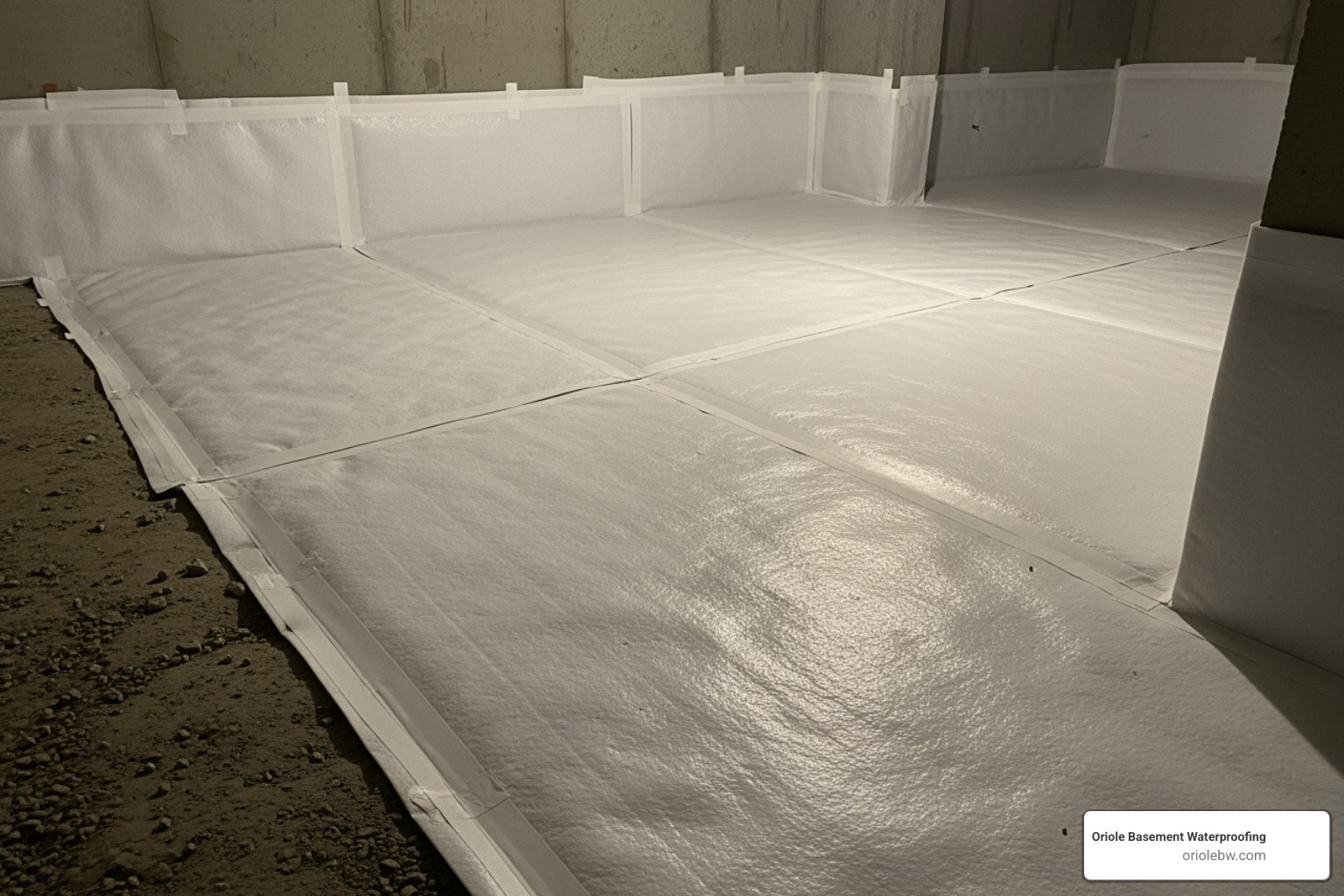
Professional installation of a thick, white vapor barrier – the foundation of any effective encapsulation system.
How Sump Pumps and Dehumidifiers Fit In
Even the best vapor barrier needs teammates. That’s where sump pumps and dehumidifiers come in.
If your crawl space deals with standing water from groundwater or heavy Maryland storms, a sump pump system is essential. We install it at the lowest point of the crawl space, often with an interior drainage system, to collect and discharge water safely away from your foundation.
For homeowners in Baltimore and surrounding areas, we also offer Sump Pump Battery Backups in Baltimore, MD because power outages often happen during the worst storms.
Dehumidifiers manage the humidity in the air, which is crucial for preventing mold growth and dust mites. The specialized crawl space models we install are powerful, efficient, and self-draining, so you never have to empty a bucket. They quietly maintain optimal humidity levels, protecting your home’s structure and improving your air quality.
Encapsulation vs. Simple Insulation
Many homeowners think adding insulation is enough to solve crawl space problems, but crawl space encapsulation systems work on a completely different principle.
Traditional fiberglass insulation is the wrong solution for a damp crawl space. When it gets wet, it absorbs water like a sponge, loses its insulating power, sags, and becomes a breeding ground for mold and pests.
In a properly encapsulated crawl space, we install rigid foam insulation boards on the crawl space walls, not between the floor joists. In an encapsulated system, the walls become your thermal boundary. The key difference is that encapsulation focuses on moisture control first. We create a dry environment, then add insulation that can do its job effectively. Without encapsulation, insulation alone is like trying to stay dry in a rainstorm with a cotton sweater; it just won’t work.
The Do’s and Don’ts of Crawl Space Encapsulation
Getting crawl space encapsulation systems right the first time is the difference between a solution that lasts for decades and one that fails in a few years. After more than 70 years working in Maryland and Pennsylvania crawl spaces, we’ve seen what works and what doesn’t.
While encapsulation may seem straightforward, the science behind it is complex. Missing a step or using the wrong materials can lead you right back to the problems you started with. Here are the essential practices to ensure your investment pays off.
What to Do for a Successful Encapsulation
- DO: Address water sources first. Encapsulating over existing water problems won’t work. We handle any standing water, leaks, or groundwater seepage first, often by installing drainage systems and sump pumps to direct water away from the foundation.
- DO: Use durable, mold-resistant materials. The heavy-duty, 20-mil reinforced polyethylene vapor barrier we use is engineered to resist punctures and tears for decades. Cheap materials fail and cost more in the long run.
- DO: Seal all air leaks completely. This means permanently closing every vent with airtight covers and sealing all gaps and cracks. Even a small leak can let in enough humid air to undermine the entire system.
- DO: Install a dehumidifier. A high-quality, self-draining dehumidifier designed for crawl spaces is essential for maintaining humidity below 55%, preventing mold growth and ensuring healthy air quality.
- DO: Trust a professional. Proper installation requires understanding moisture dynamics and using the right techniques for our Mid-Atlantic climate. A professional ensures all components work together as intended.
What to Avoid When Encapsulating Your Crawl Space
- DON’T: Use thin plastic sheeting. Standard 6-mil plastic from a hardware store tears easily and breaks down over time, failing to provide the long-term protection your home needs.
- DON’T: Leave vents open. The goal of encapsulation is to create a sealed environment. Open vents defeat the purpose by letting in humid outside air.
- DON’T: Ignore structural repairs. If your crawl space has sagging floors or rotting joists, these must be fixed first. We handle sill plate, support beam, lolli column, floor joist, and subfloor replacement, as well as installing carbon fiber straps for bowing walls.
- DON’T: Assume it’s a DIY project. Mistakes from DIY attempts often cost more to fix than professional installation would have in the first place. It requires technical knowledge and specialized equipment.
- DON’T: Use fiberglass insulation. Fiberglass absorbs moisture, loses its effectiveness, and becomes a breeding ground for mold. In an encapsulated space, rigid foam insulation on the walls is the correct, effective solution.
The Lasting Payoff: Long-Term Advantages of Encapsulation
Homeowners in Maryland and Pennsylvania often ask if crawl space encapsulation systems are worth the investment. Our answer is always yes. Encapsulation is more than a moisture fix; it’s an investment in your home’s future, preventing headaches, health issues, and costly repairs.
It improves your family’s health, increases property value, and provides peace of mind. A properly encapsulated crawl space shows potential buyers that a home has been cared for from the foundation up.
How Encapsulation Creates a Healthier Home
Here’s a surprising fact: up to 60% of the air you breathe inside comes from your crawl space. When that space is damp and moldy, those contaminants rise into your living areas.
Crawl space encapsulation systems change this by creating a sealed, dry environment. This eliminates the conditions that allow mold spores, dust mites, and other allergens to thrive, resulting in improved indoor air quality. According to the U.S. Environmental Protection Agency, controlling moisture is the key to controlling mold in your home.
We’ve had customers tell us their family’s allergy symptoms virtually disappeared after encapsulation. That’s the power of clean, dry air.
Mold spore elimination is a major benefit. No moisture means no mold growth, which gets rid of musty smells and worries about what’s growing in the dark. Encapsulation also creates an effective pest barrier, as mice, spiders, and other pests lose their damp habitat and can no longer find an easy way into your home.
Preventing Structural Damage and Saving Money
The financial benefits of crawl space encapsulation systems go well beyond the initial cost. We’re talking about real money saved over the life of your home.
Protecting floor joists is one of the biggest advantages. Wood rot is a common result of moisture in unprotected crawl spaces. Encapsulation stops this destructive process before it starts. We’ve seen homes needing floor joist replacements that cost $15,000 or more. Compared to that, the cost of preventative encapsulation is a clear financial win.
Energy efficiency is another area with immediate returns. A sealed crawl space means your HVAC system isn’t fighting humid summer air or cold winter drafts. Many customers report lowering heating and cooling bills by 15-20% after encapsulation.
The prevention of costly future repairs might be the biggest financial advantage. By addressing the root cause of moisture now, you avoid much larger expenses for structural repairs, mold remediation, and pest control later.
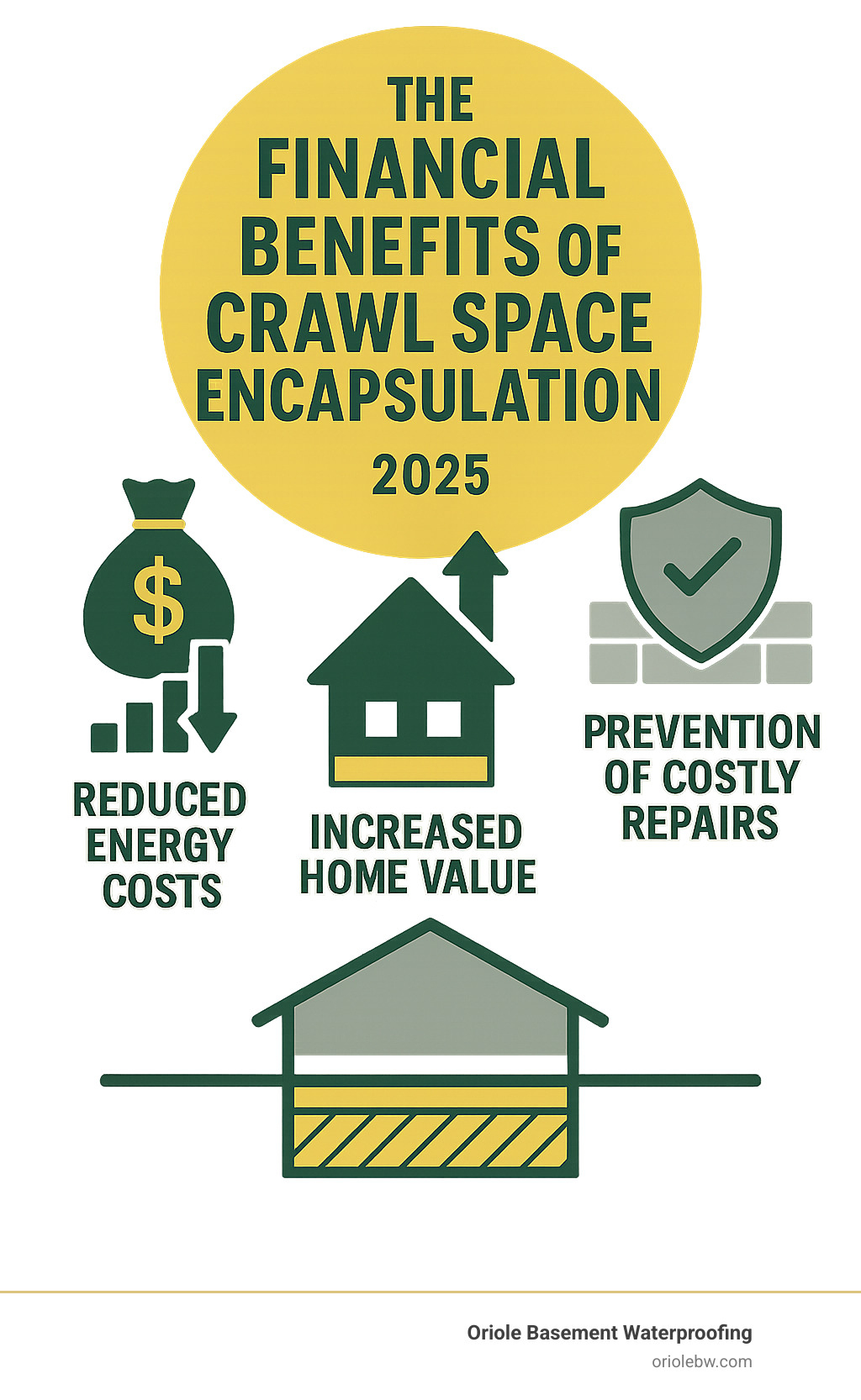
The bottom line? Crawl space encapsulation systems are an investment that protects your home’s value while improving your family’s daily life. It’s about creating a foundation for a healthier, more comfortable, and more valuable home for decades to come.
Your Local Experts in Crawl Space Health
If you’ve noticed any of the warning signs in your Maryland or Pennsylvania home, it’s time to look under the floorboards. A healthy crawl space means a healthy home, and that’s exactly what we’ve been helping families achieve for over seven decades.
At Oriole Basement Waterproofing, we’ve been the trusted local partner for creating dry, stable, and healthy foundations since 1950. We’ve seen it all – from flooded crawl spaces in Baltimore County rowhomes to moisture problems in Lancaster County farmhouses. Every project teaches us something new, but one thing never changes: crawl space encapsulation systems done right can transform your entire home.
What sets us apart isn’t just our experience, though that certainly matters. As a family-owned company, we understand the unique challenges that come with Maryland’s humid summers and Pennsylvania’s freeze-thaw cycles. We’ve watched neighborhoods grow, seen homes age, and helped thousands of families protect their most important investment.
Our approach goes beyond just installing a vapor barrier and calling it done. We bring engineering-backed solutions to every project, partnering with structural engineers when needed to ensure your home’s long-term stability. Whether we’re addressing foundation settlement in Howard County or moisture control in York County, we assess everything – drainage patterns, grading issues, humidity levels, and structural integrity. This holistic approach means you’ll never find yourself chasing the same problem year after year.
From the moment our certified technicians arrive for your initial inspection to our post-job follow-up calls, we keep you informed every step of the way. Our project managers believe in white-glove service because your peace of mind matters as much as the technical work we perform. And with our lifetime transferable guarantee, you can rest assured that your investment is protected, whether you stay in your home for decades or decide to sell.
Don’t let a damp, unhealthy crawl space undermine your home’s integrity or your family’s comfort. We’ve helped neighbors throughout Baltimore City, Anne Arundel County, Harford County, and beyond turn their problematic spaces into dry, clean, and valuable parts of their homes.
Our friendly team is ready to help you find the benefits of a healthy crawl space.
Ready to see what’s really happening beneath your floors? Get a free, no-obligation inspection for your crawl space and find how we can help you breathe easier in your own home.